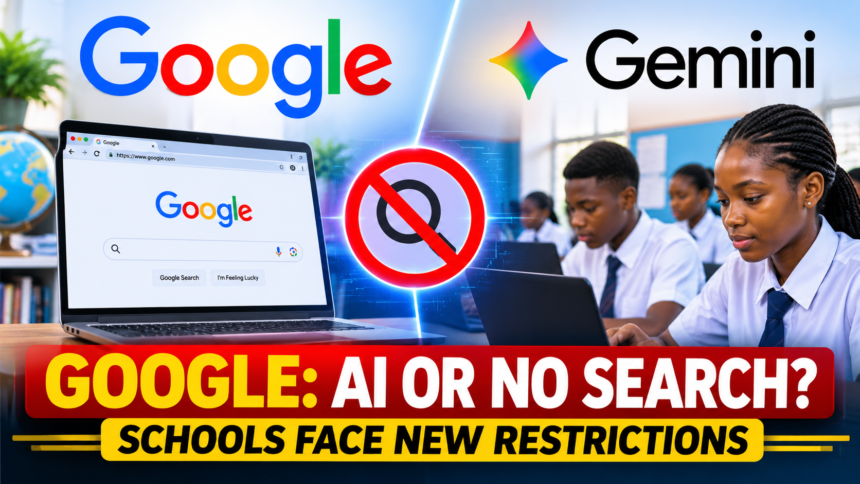
Google Search AI policy is facing growing criticism after Google announced that schools refusing to activate its artificial intelligence tools could lose access to its search engine for student accounts. The decision, announced on November 3, 2026, affects K-12 schools and introduces new restrictions involving Google Gemini, Gemini Notebook, Gemini in Classroom and Google Search.
The announcement has raised questions about schools‘ freedom to decide how artificial intelligence should be used in classrooms, particularly as concerns about children’s digital safety, academic performance and independent thinking continue to grow.
Google Makes AI Access an Administrator’s Decision
In a blog post titled Designing Responsible AI for Learning, Chris Phillips, Google’s Vice President and General Manager of Education, explained that the company was changing how schools manage access to its AI products.
Under the proposed arrangement, Gemini, Gemini Notebook, Gemini in Classroom and Google Search will be switched off by default for K-12 student accounts until school administrators explicitly enable them.
Phillips said the decision followed discussions with schools, teachers, researchers and policymakers about the growing role of artificial intelligence in education.

“We believe schools should have control over AI in their classrooms,” he wrote.
However, the arrangement comes with a significant complication. Schools that choose not to enable Google’s AI-powered Search experience will also lose access to Google Search through their student accounts.
This means administrators who want to keep students away from Google’s AI features may have to consider alternative search services for classroom research.
Google has not presented the change as a simple requirement to activate every product together. Administrators will have controls over individual services, but access to Search remains tied to its AI-integrated experience.
Why Google Search Is Becoming Part of the AI Debate
The decision is particularly significant because Google Search has long been a familiar research tool for students.
From finding information for assignments to researching historical events and understanding scientific concepts, the search engine plays an important role in everyday learning.
However, Google has increasingly incorporated artificial intelligence into its search experience through features such as AI Overviews and AI Mode.
The company is now extending this direction into education.
Its November announcement also introduced Guided Learning capabilities for Search. The feature is designed to help students understand difficult subjects through explanations and step-by-step guidance rather than simply providing answers.
According to Google, a student searching for help with a complicated physics question or a book report could receive prompts that encourage critical thinking and a better understanding of the subject.
Google plans to begin testing this Search experience in selected US schools later in November before expanding it to additional school districts.
Google Defends Its Guided Learning Approach

Google is presenting its latest education developments as an attempt to make artificial intelligence more useful for actual learning.
Rather than encouraging students to depend on chatbots for instant answers, the company says Guided Learning is designed to support what it describes as productive struggle.
The feature is intended to encourage students to work through challenging subjects, ask questions and develop their understanding.
Google also announced that teacher-led Guided Learning activities are becoming globally available in Google Classroom.
The experience allows teachers to assign learning activities based on classroom materials while receiving insights into how students engage with the lessons.
These developments form part of Google’s wider effort to integrate AI into educational environments while maintaining teacher involvement.
The company says its objective is to give school leaders greater control over how these tools are introduced.
However, critics argue that providing schools with a choice between AI-integrated Search and losing access to the search engine does not offer sufficient flexibility.
Children’s Advocacy Groups Criticise Google’s Decision

One of the strongest criticisms came from Fairplay, a children’s advocacy organisation that campaigns for stronger protections against harmful technology.
Its executive director, Josh Golin, argued that Google’s approach could damage trust between the company and educational institutions.
“Google’s attempt to strong-arm schools into using its AI products is likely to backfire,” Golin said in a November 3 statement.
He also questioned whether Google’s growing presence in schools was primarily serving educational interests or encouraging long-term dependence on its products.
Fairplay urged schools to consider alternatives that offer stronger privacy protections and allow students to conduct research without relying entirely on AI-powered services.
The criticism reflects wider concerns about introducing generative AI into children’s learning environments without sufficient evidence about its long-term educational and developmental effects.
The Earlier Gemini Controversy
Google’s latest announcement follows criticism that emerged in August 2026, when the company expanded Gemini in Classroom to students of all ages who had received access through their school administrators.
Previously, access to Gemini in Classroom for students had been more restricted, particularly for those under 18.
The expansion allowed eligible students to use AI-powered study features, including tools for creating flashcards, practice quizzes and interactive learning experiences based on classroom materials.
Although Google presented the development as a way to improve personalised learning, it attracted concerns from parents, educators and children’s advocates who questioned whether younger students were ready for greater exposure to generative AI.
The latest policy change appears to acknowledge the importance of giving schools greater control over that exposure.
What the Decision Means for Schools and Students

Google’s decision could force school administrators to reconsider their existing digital learning arrangements.
Schools that want to continue using Google Search will have to evaluate the AI features included in the available student search experience. Those unwilling to enable the relevant AI access may need to explore alternative research tools.
The issue also raises a broader question about the influence technology companies have over educational environments.
Google says it will provide schools with more information in the coming months before the changes are implemented, giving administrators time to prepare.
For students, the outcome could affect how they access information, research assignments and use digital learning platforms.
Ultimately, the debate is no longer simply about whether artificial intelligence belongs in classrooms. It is also about who should decide how much access students have to the technology.
As schools continue to weigh the potential benefits of AI against concerns about privacy, academic independence and children’s development, Google’s latest decision has placed that question firmly in the spotlight.