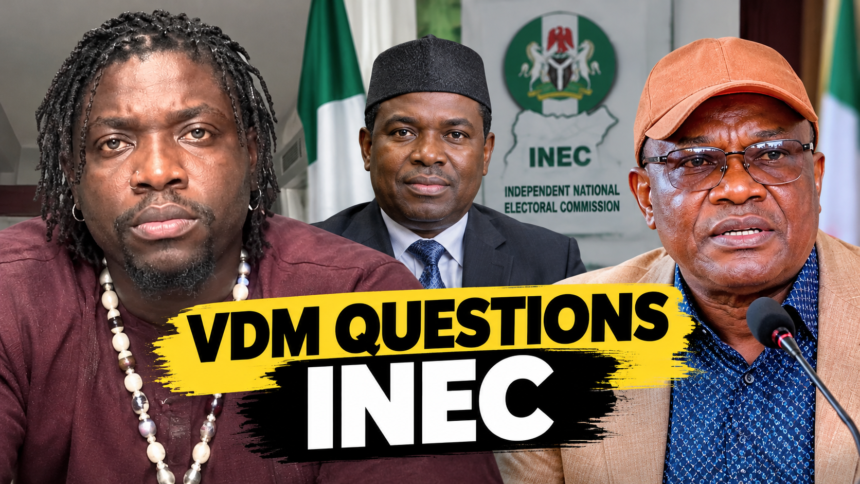
VeryDarkMan has called on the Independent National Electoral Commission (INEC) to address Nyesom Wike’s remarks about the 2027 presidential election, questioning why the commission has not responded to the minister’s declaration that the ruling All Progressives Congress (APC) has won the Federal Capital Territory (FCT).
The social media activist, whose real name is Martins Vincent Otse, expressed his frustration in a video shared on Instagram, directly addressing INEC Chairman Professor Joash Ojo Amupitan. His reaction followed comments by Wike, the Minister of the Federal Capital Territory, who dismissed the idea of targeting only 25 per cent of votes for President Bola Tinubu in the territory ahead of the next presidential election.
The controversy has raised questions about political rhetoric before an election, the responsibility of electoral authorities and the importance of reassuring Nigerians that their votes will count.
What Wike said about the 2027 election
Wike made the remarks during a media parley in Abuja, according to a report published on October 13, 2026, by iExclusiveNews.
Discussing his role in coordinating political support for Tinubu in the FCT, the minister questioned why he would aim for only 25 per cent of the votes.
“Did I come here to be coordinated for 25%? How do you look at me, coordinator of FCT? I’m looking for 25%? That must be a joke,” Wike said.

He continued: “My fight now is fighting against other parties not to near 25%. We have won in FCT.”
The statement has attracted attention because it was made ahead of the 2027 presidential election, when voters have yet to cast their ballots.
Wike’s comments reflect his confidence in the APC’s electoral prospects in the territory. However, his declaration that the party has won the FCT should not be confused with an official election result. The election has not taken place, and the final outcome will depend on the voting process and the applicable electoral rules.
It was this distinction between political confidence and an election result that became central to VDM’s criticism.
VDM questions INEC chairman Amupitan
Reacting to Wike’s remarks, VDM questioned why INEC had not publicly addressed the minister’s comments.
In the video attributed to him, the activist said: “INEC, what is the meaning of this nonsense the FCT minister has been doing? To be very honest, it’s irritating at this point. INEC, you are the only people that can announce an election result.”
He then challenged the commission over Wike’s declaration that the APC had already won the territory.
“Wike is telling us now that they’ve won FCT even before the election and INEC is not saying anything. They are not countering him. It makes absolutely no sense that they have won the FCT,” VDM said.
The activist also addressed the INEC chairman directly, asking: “The INEC chairman, Joash Ojo Amupita SAN, what’s the meaning of this nonsense?”

His objection was not simply that Wike had expressed support for Tinubu. Rather, VDM argued that announcing victory before voting could create the impression that the electoral outcome had already been decided.
He maintained that INEC should clarify its position and reassure Nigerians that the outcome of the election would be determined through the established electoral process.
Why the 25 per cent threshold mattersThe dispute also touches on the constitutional requirement for presidential candidates to secure a specified spread of votes across Nigeria.
Section 134(2) of the 1999 Constitution, as amended, sets out the conditions a presidential candidate must satisfy to be elected. These include securing the highest number of votes and obtaining at least one-quarter of the votes cast in at least two-thirds of all the states of the federation and the Federal Capital Territory, subject to the circumstances specified in the Constitution.
The FCT’s place in this provision has made the 25 per cent threshold a recurring subject of political and legal debate.
Wike’s remarks focused on preventing opposition parties from approaching that threshold in the territory. His statement that the APC had already won the FCT was a political declaration, not an official result issued by INEC.
VDM questioned the implication of such confidence, arguing that the electoral commission should not remain silent when political comments risk making voters feel that their participation will not affect the outcome.
However, the minister’s statement alone does not establish that electoral manipulation has occurred or that there is a plan to interfere with the 2027 election. Any allegation of wrongdoing would require separate evidence.
VDM says Nigerians’ votes must count

VDM’s criticism centres on the principle that elections should be decided by voters rather than declarations made before polling day.
His intervention reflects a broader concern about public confidence in Nigeria’s electoral process. When political figures speak as though a contest has already been settled, voters may question whether their participation will make a difference.
At the same time, politicians are entitled to campaign, mobilise supporters and express confidence in their candidates. The crucial distinction is between predicting victory and suggesting that the result is guaranteed regardless of how people vote.
For INEC, the challenge is to maintain public confidence through transparent administration, clear communication and the consistent application of electoral rules.
A response to VDM’s concerns, if issued, would need to come from an official commission statement or verified communication. No response should be attributed to INEC without confirmation.
Will INEC respond to VDM’s concerns?

VDM’s demand places INEC Chairman Amupitan at the centre of a debate over political statements ahead of the 2027 general election.
The activist wants the commission to address Wike’s declaration that the APC has won the FCT before votes have been cast. His concern is that such comments could undermine confidence in the process and leave Nigerians questioning the value of their votes.
The immediate question is whether INEC will publicly clarify its position on the remarks.
For now, Wike’s comments and VDM’s reaction have brought renewed attention to the importance of distinguishing political predictions from official election results. As the 2027 contest approaches, maintaining confidence in the process will require political leaders and electoral authorities to communicate responsibly and ensure that claims about electoral outcomes are not mistaken for results established through voting.
Ultimately, the APC’s prospects in the FCT will be tested at the ballot box. Until then, the election remains ahead, and no political declaration can substitute for the official process of voting, counting and announcing results.