

The alleged production of 40,000 Tinubu campaign tablets in China has sparked criticism among Nigerians, with many questioning why the devices were not manufactured or assembled locally to create jobs and support the country’s technology industry ahead of the 2027 general elections.
The controversy emerged after a Nigerian visitor to a Chinese factory shared a video showing tablet packaging bearing President Bola Ahmed Tinubu’s photograph, alongside campaign-related inscriptions and branding associated with his political movement.
The footage, which circulated on social media on Saturday, October 31, 2026, has generated questions about the reported order, its financing and the decision to source the devices from China when Nigeria has businesses operating in the technology sector.
Tinubu Campaign Tablets: What the China Factory Video Shows
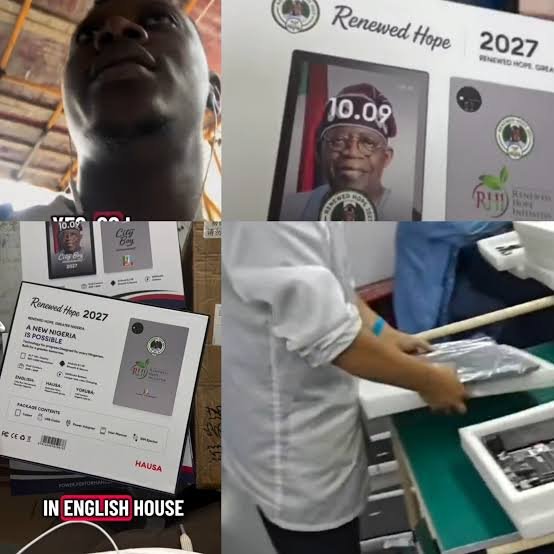
The video, shared by Nigerian social media personality Dj SpoiltKid, shows the visitor examining stacks of tablet packaging carrying Tinubu’s photograph and political campaign inscriptions.
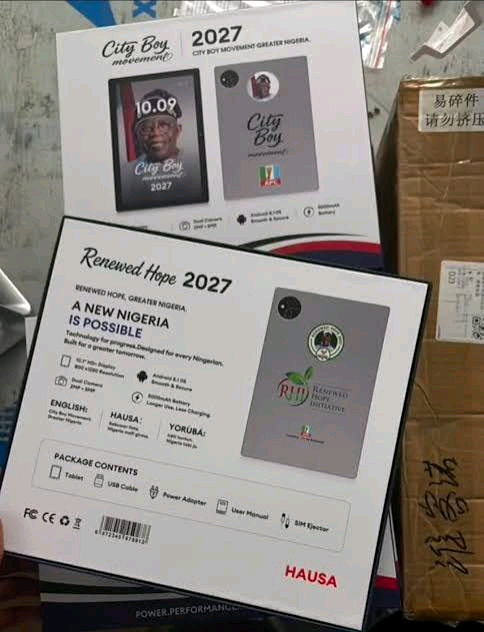
Some of the visible messages include ‘Renewed Hope 2027′, ‘City Boy Movement 2027’ and ‘A New Nigeria Is Possible’.
The packaging also identifies English, Hausa and Yoruba as the languages supported by the devices, suggesting that the tablets are customised with content intended for different language-speaking audiences.
During the factory visit, a representative reportedly indicated that the facility had received an order for 40,000 units.
The revelation attracted attention because the devices appear to be designed for political communication and campaign activities rather than ordinary commercial distribution.
However, the footage does not independently establish the identity of the organisation that placed the order, the amount involved or the source of the funding.
Neither has the reported production arrangement been independently confirmed by the All Progressives Congress (APC) or the Presidency.
Why Nigerians Are Questioning Production in China

Much of the criticism surrounding the development centres on the decision to manufacture the devices outside Nigeria.
Several Nigerians have argued that an order involving 40,000 electronic devices could have provided an opportunity for local technology companies to secure contracts, expand their operations and employ more workers.
Reacting to the video on X, user Okiki Ola questioned why Nigerian technology entrepreneurs were not considered for the reported production.
He wrote, “So, what happened to the tech guys in Nigeria? You can’t empower your own youth as sitting President. Forty thousand tablets, bro. Do you know what that would do to Nigeria’s economy if given to a Nigerian to produce in Nigeria?”
His reaction reflects concerns that large procurement orders, particularly those involving technology products, could help strengthen domestic businesses when local companies have the necessary capacity.
Another user, Don Creative, argued that developing local manufacturing or assembly capacity could have created employment opportunities and reduced the country’s dependence on imported technology.
He wrote, “Instead, we chose to fund another country’s economy while remaining perpetually dependent. Nigeria can, and should, prioritise investments that deliver long-term value to our people.”
The reactions have also drawn attention to the wider challenge of building a technology industry capable of competing with foreign manufacturers.
Nigeria’s Technology Industry and Local Manufacturing Debate
The controversy has renewed discussions about Nigeria’s ability to manufacture and assemble electronic devices rather than depend heavily on imports.
The National Information Technology Development Agency (NITDA) has an established framework for registering and certifying Original Equipment Manufacturers (OEMs) operating in the country’s information technology sector.
According to the agency, its certification process covers companies involved in designing, developing, manufacturing, assembling and selling technology devices in Nigeria.
NITDA explains that the framework is intended to assess the technical and production capacity of local technology companies while promoting Nigerian IT products and services in line with Executive Order 003.
The policy provides a basis for encouraging local participation in technology production and strengthening domestic capacity.
Although the existence of certified technology businesses does not automatically establish that a Nigerian manufacturer could have delivered the reported 40,000 tablets within the required specifications and timeframe, critics believe the development raises questions about whether local production or assembly options were explored.
Engaging Nigerian businesses in suitable contracts could also provide opportunities for technical training, employment and investment in the country’s manufacturing sector.
Nigerians Question the Funding of the 40,000 Tablets
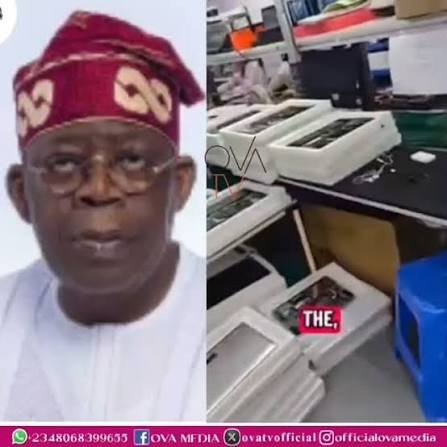
Beyond the location of production, the alleged order has raised questions about who is paying for the devices.
Some social media users have linked the reported production to government spending, arguing that public resources should be directed towards essential services rather than political campaign materials.
Toochukwu Asiegu criticised what he considered misplaced spending priorities, writing, “This is how Tinubu is spending 2024/2025 and 2026 budgets. He must induce Nigerians with something. Money meant for primary healthcare, education and other critical areas is used to produce campaign items. Over to you, Nigerians.”
Other reactions similarly questioned whether the resources involved could have been directed towards infrastructure, healthcare, education and employment.
However, the funding allegations remain unestablished.
The appearance of Tinubu’s photograph and campaign branding on the packaging does not, on its own, prove that the Federal Government financed the production.
Another X user, Joe Bills, challenged the assumption that the order was government-funded, asking, “How do you know it’s government doing this and not a private citizen?“
His question highlights an important distinction in the controversy: the alleged production of campaign devices, the identity of the organisation behind the order and the source of its funding are separate issues that require clarification.
Questions Remain Over Tinubu’s Alleged Campaign Tablets
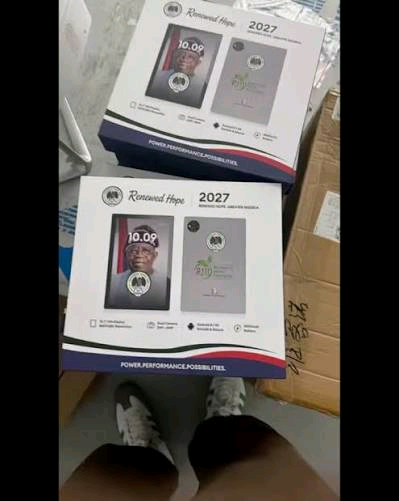
The viral footage has brought attention to the reported production of 40,000 Tinubu-branded tablets in China, but several important details remain unclear.
These include the identity of the contracting party, the total production cost, the intended recipients of the devices and whether the reported order has been completed.
There is also no independently confirmed information establishing whether local Nigerian manufacturers were approached or considered before the production reportedly commenced in China.
For many Nigerians, however, the controversy goes beyond the tablets themselves. It has reopened the debate about local manufacturing, job creation and the country’s dependence on imported technology.
As discussions surrounding the 2027 general elections gather momentum, questions about how campaign materials are sourced and financed are likely to remain part of the wider political conversation.