


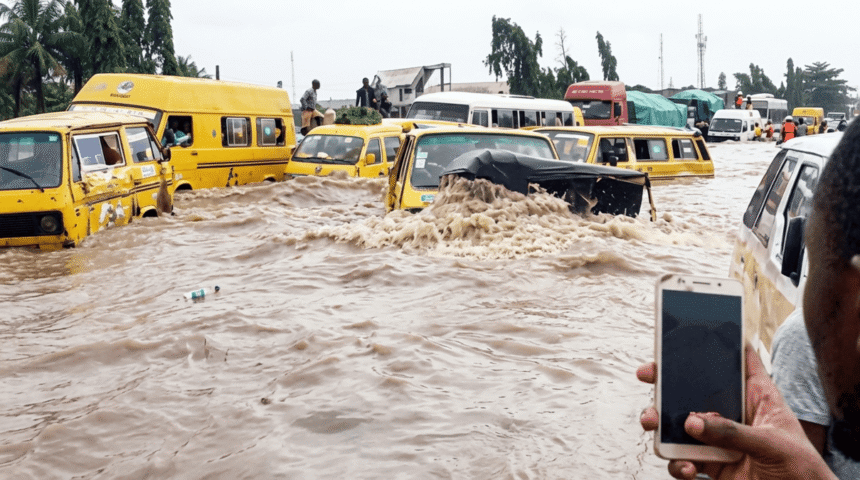
Flash floods submerged Lagos roads on Sunday, stranding motorists and commuters across nine major routes from Ikorodu to the Lekki-Epe Expressway.
Sunday’s floods came fast. By noon, Lagos was already drowning nine major corridors from Ikorodu to the Lekki-Epe Expressway swallowed whole by water that had nowhere to go, stranding motorists and commuters across a city still unprepared for rain it had been warned about.
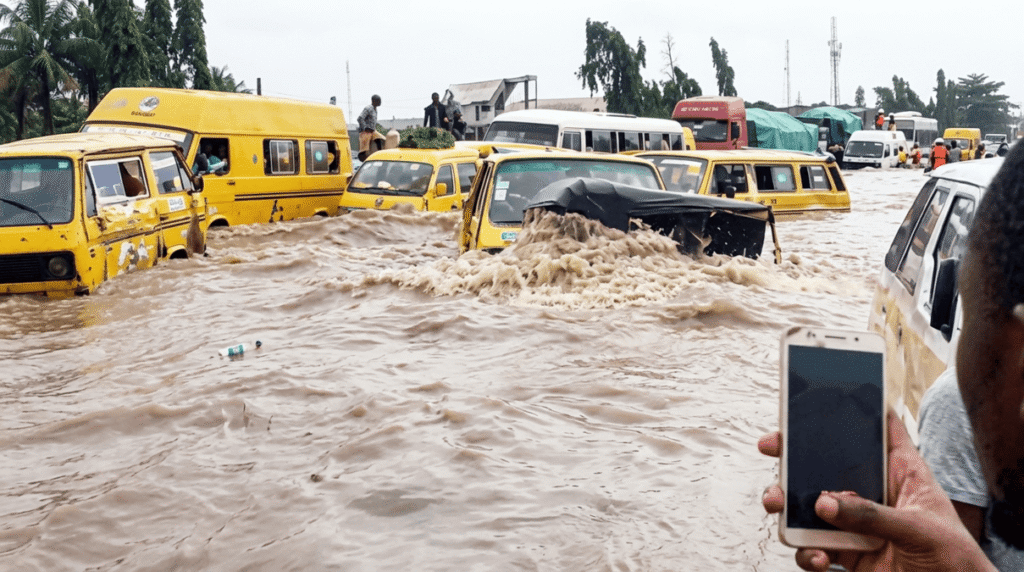
The downpour struck the metropolis around noon and did not relent until approximately 3 p.m. But those three hours were enough to paralyse movement on the Lagos-Ibadan Expressway, Ikorodu Road, Lagos-Abeokuta Expressway, Oshodi, Agege, Ikeja, Alimosho, Obalende and the Lekki-Epe Expressway simultaneously.
By 2 p.m., bus queues at Oshodi had stretched beyond 300 metres. Passengers abandoned danfo buses, stalled axle-deep in brown floodwater, grabbed their bags, and walked. And at Ojuelegba, the scene was identical: a long, defeated line of people going fast in different directions.
Johnson Alaba uses the Apapa-Oshodi Expressway daily. He told reporters on Sunday that blocked drainage channels turned what should have been an inconvenience into full submersion. “The entire road is under water and there is no movement. The drainage channel is not functional here,” he said.
Further down the same corridor, a motorist who gave only his first name, Tony, described driving from Isolo to Mile 2 as something closer to wading. “I practically swam through the flood with my car,” he told reporters. Heaps of refuse dumped along the expressway, he noted, had compounded the flooding significantly.
Tony went further. Unless the state government tackled waste disposal near drainage channels before the September peak, he warned, Lagos risked a public health emergency the rains had not yet finished building toward. And Sunday, he said, was only a preview.
At Gbagada, vehicles that pushed through submerged sections broke down on the other side, their owners crouched on the roadside inspecting engines for water damage. Ikota sustained complete road submersion. Yet traffic reports continued arriving from areas where conditions were worse.
Muri Okunola Road in Ajah, Eti-Osa Local Government Area, went under by roughly 200 metres. Commuters waded through waist-deep water to move at all. Mrs. Rukayat, a resident reached by phone, confirmed that vehicles became useless on that stretch before midday.
“The only way to pass through the water was by walking or using a tricycle,” Mrs. Rukayat told Westtrybe. Even the tricycles broke down mid-crossing and had to be pushed through. But she said residents had no other option and kept trying anyway.
Mafoluku told a harder story. Entire streets, homes and access roads went under, leaving residents unable to return. Mrs. Iriagbonse Okunkpolor of Agboola Street had stepped out to buy household items and spent hours marooned, with no safe route back to her own front door.
Mr. Mukaila Idris, also of Mafoluku, watched the current move people off their feet. Young men stationed themselves at the worst crossings and charged to carry passengers through. “I watched people pay them because they were afraid of being swept away,” he told reporters Sunday afternoon.
Tokunbo Wahab, Lagos State Commissioner for the Environment and Water Resources, urged residents not to panic. He described Sunday’s event as temporary flash flooding that would recede within hours. But he also pointed to a factor beyond blocked drains that rarely features in public conversation about Lagos floods.
Wahab disclosed that high tidal movement frequently prevents drainage channels from discharging stormwater into the lagoon. “Whenever there is high tidal movement, it may block the discharge points of drainage channels until the water level recedes,” he explained. Backflow, he noted, follows inevitably once that blockage holds.
The Nigerian Meteorological Agency had already flagged the risk. NiMet’s forecast issued before Sunday predicted thunderstorms and widespread rainfall nationally, with flash floods likely in vulnerable areas. And Lagos, by every measure, qualifies as one of Nigeria’s most flood-vulnerable cities.
The Nigeria Hydrological Services Agency and the Lagos State Ministry of Environment had together projected, in their 2026 Annual Flood Outlook, that this season would run from late March through the first week of December. Heavier-than-usual rainfall was the explicit warning attached to that forecast.
Lagos drains poorly because its drains are blocked, its waterways are built over, and its population has outgrown the infrastructure meant to carry rainwater away. Rapid urbanisation has accelerated every one of those problems. Sunday was not an anomaly it was the season doing exactly what forecasters said it would do.
Residents in Ajah, Mafoluku and Eyinogun told Westtrybe the damage pattern was unchanged from prior seasons. They called on the Lagos State Ministry of Environment and Water Resources to act before Septembcommuters;the flood peak arrives. Sunday’s floods did not just strand commuters they marked a city where clogged drains decide who gets home.