


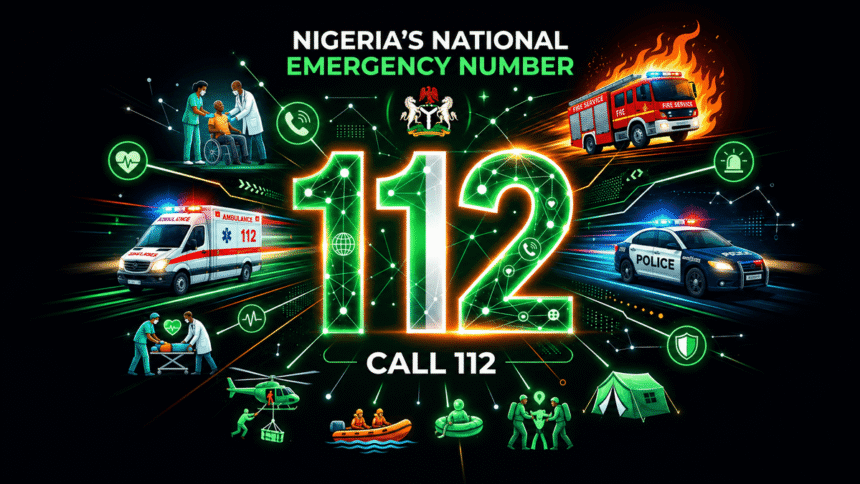
The federal government has moved to make 112 Nigeria’s single emergency telephone number, directing the Nigerian Communications Commission to draw up a full implementation plan and coordinate with relevant agencies across the country.
Vice President Kashim Shettima gave the directive during a meeting with a delegation from the NCC at the Presidential Villa on Tuesday. The NCC delegation was led by the Chairman of its Governing Board, Chief Idris Ibikunle Olorunnimbe.
The move follows an earlier decision by the National Economic Council, which Shettima chairs, to formally approve 112 as the national emergency number. That approval was aimed at building a unified emergency response system that cuts across federal, state, and local government levels.
NCC Chairman Calls on Governors, Police, and NEMA to Back the 112 Initiative
Shettima directed the NCC to work alongside the National Emergency Management Agency to strengthen nationwide emergency coordination. He also called for high-level commitment from emergency responders as the government pushes the initiative forward.
A statement issued on Thursday by the Senior Special Assistant to the President on Media and Communications in the Office of the Vice President, Stanley Nkwocha, said Shettima assured the delegation that funding for the project would be mobilized through the National Economic Council and through private sector participation.
Olorunnimbe told the vice president that the NCC had already established about 35 emergency communications centers across Nigeria. He warned, however, that sustained support from state governments and emergency agencies was needed to keep those facilities running.
He said governors, the Nigeria Police Force, ambulance services, and NEMA must all work together to ensure that Nigerians in distress receive quick assistance. Without that cooperation, he said, the centers could not function at the level required.
Olorunnimbe put it plainly: everyone was expected to recognize the importance of the initiative and treat participation as a patriotic obligation, not an optional commitment.
Federal Government to Engage State Governors on Emergency Number Rollout
Beyond the NCC meeting, the federal government said it would begin direct engagement with state governors and emergency response agencies to finalize the nationwide rollout of the 112 emergency number. The timeline for full deployment was not disclosed.
Nigeria has historically operated with fragmented emergency contacts across agencies, making it difficult for members of the public to know which number to call during a crisis. Police, fire services, and ambulance units have operated on separate lines with uneven coverage and response capacity across states.
The adoption of 112 as a unified national emergency number is intended to simplify access to help and cut the time it takes for distress calls to reach the right responders. The number already serves as the standard emergency contact in several countries.
The NCC’s 35 emergency communications centers represent existing infrastructure the government wants to build on. The challenge, officials acknowledge, is operational: the centers require consistent funding, adequate staffing, and round-the-clock commitment from agencies that have not always prioritized emergency communications in their budgets.
Shettima’s directive to the NCC to produce a formal roadmap signals that the government wants a structured plan before engagement with state governors begins. Details of the roadmap and any attached timeline were not immediately available.
The National Economic Council’s earlier approval of the 112 number gave the initiative formal backing at the highest level of intergovernmental coordination in Nigeria. With 36 state governors sitting on that council, the approval carries weight beyond the federal bureaucracy alone.
Whether state governments will follow through with the operational and financial commitments needed to make the 112 emergency number work remains to be seen. Officials at Tuesday’s meeting did not specify what consequences, if any, states would face for failing to integrate into the national system.
The NCC and NEMA have not issued separate statements on next steps. Further details on the implementation roadmap are expected as the government’s engagement process with state governors gets underway.