The National Industrial Court in Lagos has ordered the Nigerian Army to immediately reinstate 70 soldiers whose 2014 convictions were wiped out by a presidential pardon, bringing to an end a 12-year legal battle that began with mutiny charges during the Boko Haram insurgency.
However, the court rejected the soldiers’ demand for eight years of back pay, ruling that a pardon does not operate retroactively to pay for services not rendered.
Judgment Delivered In Lagos
Delivering judgment on Monday, July 20, 2026, Presiding Judge Hon. Justice S.A. Yelwa held that the unconditional presidential pardon granted to the officers completely obliterated their 2014 court-martial convictions and subsequent dismissals.
The court ordered the Chief of Army Staff to immediately reinstate the 70 personnel as soldiers of the Nigerian Army. The judge said the pardon restored them as “new men” under the law.
But the court partially denied their prayers by refusing to order payment of accumulated salaries and allowances from December 17, 2014 to July 17, 2022, the period they were out of service.
The Road To The Lawsuit
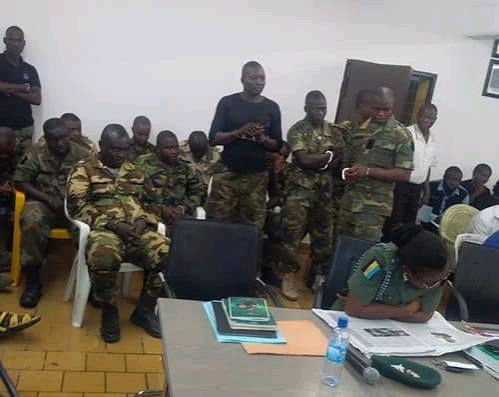
The 70 claimants, including Cpl. Andrew Ogolekwu, Cpl. Saturday Efe, and 68 others, were regular soldiers convicted of conspiracy and mutiny by military courts-martial in 2014.
They were initially sentenced to death for refusing to fight Boko Haram insurgents without adequate weapons. Upon administrative review, the death sentences were commuted to 10 years’ imprisonment.
After completing their prison terms, the soldiers were granted a full presidential pardon on July 18, 2022 by former President Muhammadu Buhari, GCFR, under Section 175 of the 1999 Constitution. The pardon was published in the Federal Republic of Nigeria Official Gazette, S.I. No. 58 of 2022.
Represented by human rights firm Falana & Falana’s Chambers, the soldiers wrote to Army Headquarters on November 9, 2022, demanding immediate reinstatement and back pay. When the military did not act, they filed suit NICN/LA/54/2023 against the Attorney General of the Federation and the Chief of Army Staff.
Key Legal Arguments And The Court’s Reasoning
The soldiers argued that the pardon erased both the conviction and the dismissal, and that they were entitled to be returned to service with all benefits.
The Army opposed reinstatement and back pay, contending that the men had been validly dismissed following court-martial proceedings.
Justice Yelwa agreed that the pardon nullified the convictions and dismissals, making reinstatement mandatory. On back pay, however, the court held that while the pardon restored their status, it does not automatically entitle them to salaries for the period they were not in active service. The judge ruled that a pardon wipes out punishment but does not operate retroactively to create a right to remuneration for work not done.
Other Military Reinstatement Cases
The judgment adds to a growing list of court decisions ordering the reinstatement of military personnel.
Between 2019 and 2021, the National Industrial Court declared the compulsory retirement of several senior officers illegal and ordered their reinstatement. They include Maj. Gen. Ijioma Ijioma, Brig. Gen. Abubakar Sa’ad, Cols. Nwankwo, Hassan and Suleiman, and Lt. Cols. Thomas Arigbe, Dazang and Mohammed.
In 2019, the ECOWAS Court also ordered the reinstatement of over 244 soldiers dismissed in 2016 for allegedly absconding from the Boko Haram fight, and directed payment of salary arrears.
Human rights lawyer Femi Falana, SAN, who represented the 70 soldiers, has repeatedly called on authorities to comply with court judgments to protect morale and the rule of law in the military.
For the 70 soldiers, the ruling means a return to active service with rank, seniority and other privileges restored, but without compensation for the years spent in prison and out of the army.
For the Nigerian Army, the order creates an immediate administrative task: processing reinstatement, postings, and records for 70 personnel whose service was interrupted for more than a decade.
The case also highlights the tension between military discipline and due process. The soldiers were convicted in 2014 for demanding weapons amid the insurgency, a decision that drew public sympathy at the time. Their eventual pardon by President Buhari was seen as a recognition that the punishment was excessive.
The court did not give a specific timeline, but ordered “immediate” reinstatement. It remains to be seen how quickly Army Headquarters will implement the judgment.
Falana & Falana’s Chambers said the ruling affirms that even in matters of national security, due process and presidential clemency must be respected.
With this decision, 70 soldiers who were once condemned to death and later jailed are set to wear the Nigerian Army uniform again, this time, as men the law now regards as never having been convicted.