
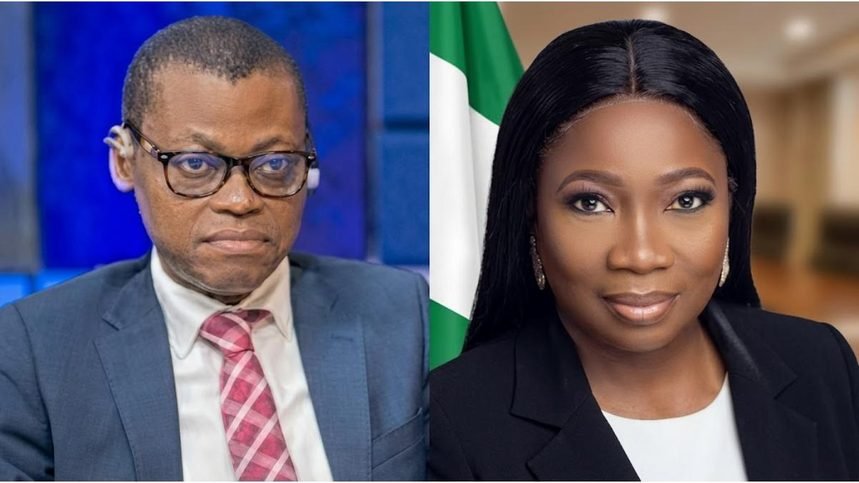
The confrontation came into the open on Saturday at a panel session in Lagos, held during an event marking Kike Abati’s 20th anniversary in the media industry. Dabiri did not hold back. She named Oseni directly, in front of a room filled with media professionals and government figures.
Dabiri accused journalists of abandoning professional values, recounting how Oseni had allegedly misinterpreted her response to a social media post as an endorsement of an offensive description of Igbo people. She said the controversy began after she responded with a smiling emoji to a post by a social media user she identified as Stephanie, who allegedly operated an X account under the name “Voice of Igbos.”
She said she had investigated the account and discovered the identity of the operator, whom she named only as Stephanie, and that the woman had repeatedly attacked her on social media, prompting her to respond to a comment on one of the posts. That single emoji, Dabiri said, was what Oseni turned into a headline.
According to the source text attributed to Dabiri, “Because I did a smiley at a post that called Igbos gorillas, Rufai Oseni comes and says Abike Dabiri calls every Igbos monkey and gorilla; that is irresponsible journalism.” The argument is precise: she reacted to a post, not to its content.
Dabiri maintained that she had not made the statement attributed to her, faulting journalists for amplifying claims without exercising due responsibility. “We have to ensure that you hold people responsible, but you must be responsible yourself. So we will not accept irresponsible journalism,” she said.
She also called on Dr. Reuben Abati by name to act, saying journalism has deteriorated to a point that demands intervention from respected figures in the profession. The appeal was public, direct, and on the record.
Dabiri said the story went viral even though, in her words, “I didn’t say Igbos.” That specific denial is the part of this story most outlets buried. Dabiri’s position is not that the post was acceptable. Her position is that she never made the statement attributed to her.
Oseni replied in a series of posts on X, accusing Dabiri-Erewa of using a public event to attack him rather than to address the issues facing Nigerians abroad. He alleged that her demeanor changed when she saw him arrive at the event and that she could not help mentioning his name during the panel discussion.
Oseni maintained that Dabiri’s reaction to the social media comment amounted to an endorsement of a “racist” post. The journalist challenged Dabiri to a public debate over the controversy, saying he was ready to defend his position.
“Your problem is you can’t stand the truth. I would like to challenge you to a debate on this issue where I will speak the truth to your face and prove to the world you endorse bigotry,” he wrote. The challenge remained unanswered as of Saturday evening.
Oseni also wrote, “Abike Dabiri is more concerned about attacking Rufai Oseni in public instead of doing her job.” Both parties, then, have now put their versions of events in writing, before audiences that include millions of Nigerians online.
The original incident traced back to a post that referred to Igbos, Nigerian citizens of South-East extraction, as monkeys and gorillas. Whether Dabiri’s laughing emoji on that thread constituted an endorsement is now a matter of public dispute between two prominent Nigerian public figures.
Kikelomo Atanda-Owo Abati, wife of journalist and broadcaster Reuben Abati, held the celebration at an event in Victoria Island, Lagos. The venue, meant to honor two decades of media work, instead became the stage for one of the sharpest public clashes over journalism ethics Nigeria has seen in recent months.
What neither side has yet resolved is the question Dabiri raised directly: who, in Nigerian media, holds journalists accountable when a report about Abike Dabiri, Rufai Oseni, and a misread emoji spreads faster than any correction ever could.