



Dr Johnson Chukwuka has taken the Action Democratic Party and INEC to court, challenging Abbas-Bin Aliyu’s emergence as the party’s presidential candidate for the 2027 election.
The lawsuit, filed at the Federal High Court in Abuja, places the circumstances surrounding the ADP’s presidential nomination under judicial scrutiny and asks the court to determine whether the process that produced Aliyu as the party’s candidate was valid.
Chukwuka, one of the party’s presidential aspirants, is seeking to overturn the disputed nomination and have himself recognised as the ADP’s presidential candidate.
Chukwuka challenges ADP presidential nomination
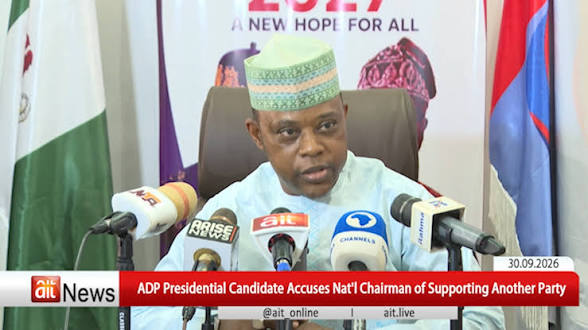
In Suit No. FHC/ABJ/CS/1853/2026, Chukwuka is asking the court to declare that the ADP failed to conduct a valid presidential primary on May 29 and 30, 2026.
He is also challenging what he describes as the “purported declaration” of Aliyu as the winner and the subsequent submission of Aliyu’s name to the Independent National Electoral Commission.
According to Chukwuka’s case, the process violated Sections 29, 77, 84, 86 and 88 of the Electoral Act 2026, as well as provisions of the ADP’s guidelines governing its primaries.
The aspirant is seeking an order setting aside the purported results and a declaration that he is the duly elected presidential candidate of the party from the May 29–30 exercise.
Those are the plaintiff’s claims and requested reliefs. They have not been established as findings of the court.
How Aliyu emerged remains disputed
The circumstances surrounding Aliyu’s emergence are an important part of the case because available reports describe the May 29–30 process differently.
Chukwuka’s lawsuit characterises the exercise as a presidential primary and challenges the purported declaration of Aliyu as its winner.
However, a separate report on the ADP’s National Convention said Aliyu’s emergence was ratified through a consensus arrangement. The report said delegates from the 36 states and the Federal Capital Territory endorsed his candidacy after consultations involving party leaders, aspirants and other stakeholders.
That creates a distinction the article cannot simply gloss over.
If the party’s process was a consensus arrangement, the legal question is different from a conventional contested primary in which aspirants compete for votes and one candidate emerges as the winner.
Chukwuka’s position, however, is that the May 29–30 process should be treated as a primary and that the purported outcome should be voided.
The available reports do not independently establish how the consensus arrangement and the primary described in Chukwuka’s suit were legally structured or whether they referred to different stages of the same nomination process.
Aliyu’s name was submitted to INEC

The dispute also extends to INEC because Aliyu’s name was subsequently submitted to the commission as the ADP’s presidential candidate.
Chukwuka is challenging that submission as part of his lawsuit.
His campaign team said Aliyu’s name was published on INEC’s notice board on August 1 and described the submission as wrongful, unlawful, unconstitutional, null and void.
The August 1 publication should not be confused with INEC’s later final candidate list. The commission published candidates’ personal particulars and credentials in August as part of the statutory process for public scrutiny, while a separate final list was published in September.
This distinction is important to the chronology of the case.
Chukwuka’s challenge concerns the validity of the party nomination and the subsequent submission of Aliyu’s name to the electoral commission.
What Chukwuka is asking the court to do

Chukwuka is seeking judicial intervention to set aside the disputed nomination process.
His requested reliefs include an order voiding the purported results and a declaration that he is the duly elected ADP presidential candidate from the May 29–30 exercise.
That requested declaration is Chukwuka’s position in the lawsuit; it does not mean the court has accepted that a valid primary occurred or that he was its winner.
The central legal questions will therefore include what process the ADP actually conducted, whether that process complied with the party’s rules and the Electoral Act, and what legal consequences should follow if the court finds that the nomination was invalid.
The court, rather than the article, will ultimately determine the legal effect of those competing claims.
INEC’s role in the ADP dispute
INEC is named alongside the ADP because the dispute extends beyond the party’s internal nomination.
Once a political party submits a candidate’s name, the commission becomes part of the formal electoral process. In this case, Chukwuka is challenging both the party’s action in presenting Aliyu and the resulting submission to INEC.
INEC has subsequently listed Abbas-Bin Aliyu as the ADP’s presidential candidate in its published information for the 2027 election. The commission’s September final list identifies Aliyu as the ADP presidential candidate and Ike Chinazam as his running mate.
That does not mean the court has ruled on Chukwuka’s challenge. It simply establishes the candidate currently recognised in INEC’s published election information.
What the lawsuit could mean for the ADP ticket

The immediate issue before the Federal High Court is not whether the ADP will participate in the 2027 election. The party already has a candidate listed by INEC.
The legal question is whether the process through which Aliyu obtained that nomination can withstand Chukwuka’s challenge.
If the court rejects the suit, Aliyu’s nomination would remain unaffected by this particular challenge. If the court grants the reliefs sought by Chukwuka, the judgment could have consequences for the ADP’s presidential nomination and the party’s candidate information before INEC.
For now, neither outcome has been determined.
The ADP’s presidential ticket therefore remains the subject of a live legal dispute, with Chukwuka asking the Federal High Court in Abuja to overturn the process that produced Aliyu and recognise him as the party’s candidate instead.