


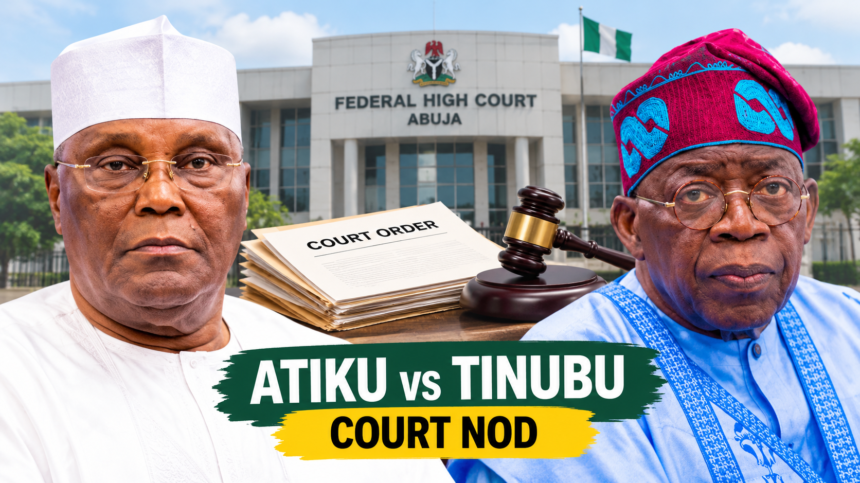
Atiku Abubakar has secured a court order to serve President Bola Tinubu through the APC in his 2027 eligibility suit over an alleged NYSC certificate issue.
Atiku Abubakar has secured a court order to serve President Bola Tinubu with legal documents in a suit challenging Tinubu’s eligibility to contest the 2027 presidential election.
The Federal High Court in Abuja on Wednesday, September 16, 2026, granted Atiku and the African Democratic Congress (ADC) permission to serve the President through his political party, the All Progressives Congress (APC), after attempts to effect personal service were unsuccessful.
Justice Inyang Ekwo made the order while ruling on an ex-parte application filed by Atiku’s legal team. The judge directed that the court processes be served through the APC within seven days.
The development allows the case to move past the immediate issue of serving the President and brings the substantive legal dispute closer to consideration by the court.
Atiku’s 2027 eligibility suit
Atiku and the ADC instituted the suit, marked FHC/ABJ/CS/1888/2026, against Tinubu, the APC and the Independent National Electoral Commission (INEC).
The plaintiffs are asking the court to determine whether Tinubu is qualified to contest the 2027 presidential election in light of allegations concerning an NYSC discharge certificate they say was submitted to INEC.
According to the plaintiffs, the certificate bears the name “Tinubu Bola Adekunle”, which they contend raises questions about the information submitted to the electoral body.
They are relying, among other provisions, on Section 137(1)(j) of the 1999 Constitution, as amended, which concerns disqualification arising from the presentation of a forged certificate to INEC.
Atiku and the ADC are asking the court to declare that Tinubu presented a forged certificate and to order INEC to remove Tinubu and the APC from the relevant list for the 2027 presidential election.
The allegations remain claims before the court and have not been established by a final judgment.
Why the court allowed substituted service
The latest ruling followed an earlier disagreement over how the legal documents should reach Tinubu.
At the September 1 proceedings, Atiku’s lawyers told the court that they had been unable to personally serve the President with the originating processes. They subsequently sought permission to use substituted service.
The issue became significant because personal service is ordinarily required for originating court processes, while substituted service allows documents to be delivered through another approved method when personal service cannot be completed.
On Wednesday, Atiku’s lawyer, O.T. Omotayo-Ojo, who appeared on behalf of Silas Onu, told the court that the plaintiffs could effect service within seven days.
Justice Ekwo subsequently granted the application and ordered that the processes be served on Tinubu through the APC within that period.
The case has now been adjourned until September 28, 2026, for mention.
Tinubu and APC challenge the case

The President and the APC have opposed the suit and asked the court to dismiss it.
In a joint counter-affidavit filed on September 9, Tinubu and the APC denied submitting any forged certificate or Form CF001 to INEC for either the 2023 or 2027 presidential elections.
Their lawyers also argued that the NYSC had not denied issuing a discharge certificate to Tinubu at the end of his service.
Tinubu and the APC further challenged the legal basis of the case, arguing that an allegation of forgery amounts to a criminal allegation that must meet the applicable evidentiary standard.
Their counsel, Akin Olujinmi, SAN, argued that the plaintiffs had not produced evidence from the NYSC disclaiming the certificate in question.
The defendants therefore asked the court to dismiss the suit rather than proceed with the claims made by Atiku and the ADC.
INEC also raises objections

INEC has separately challenged the competence of the case.
In its preliminary objection, the electoral commission raised several grounds, including statute-bar, lack of locus standi, absence of a reasonable cause of action and alleged abuse of court process.
INEC also argued that the plaintiffs did not comply with a written deposition requirement under the Federal High Court Pre-Election Practice Directions (Amendment) 2026.
The new practice directions were introduced earlier this year specifically for pre-election disputes and provide tighter procedures and timelines because of the time-sensitive nature of electoral litigation.
That means the court will have to deal not only with the allegations surrounding the certificate but also with preliminary legal questions about whether the suit can properly proceed.
What the latest ruling means
Wednesday’s order does not determine whether Tinubu is eligible or ineligible to contest the 2027 election.
Instead, it addresses a procedural step: how Atiku and the ADC can formally serve the President with the court processes after personal service proved unsuccessful.
The substantive questions remain before the Federal High Court, including the plaintiffs’ allegations concerning the NYSC certificate, the objections raised by Tinubu and the APC, and INEC’s challenges to the competence of the case.

The court’s next scheduled mention on September 28 is therefore expected to provide another stage in the ongoing legal battle.
For now, the immediate development is that Atiku has obtained judicial permission to serve Tinubu through the APC, giving the eligibility suit a clearer procedural path as the parties prepare to argue their respective positions before the court.