

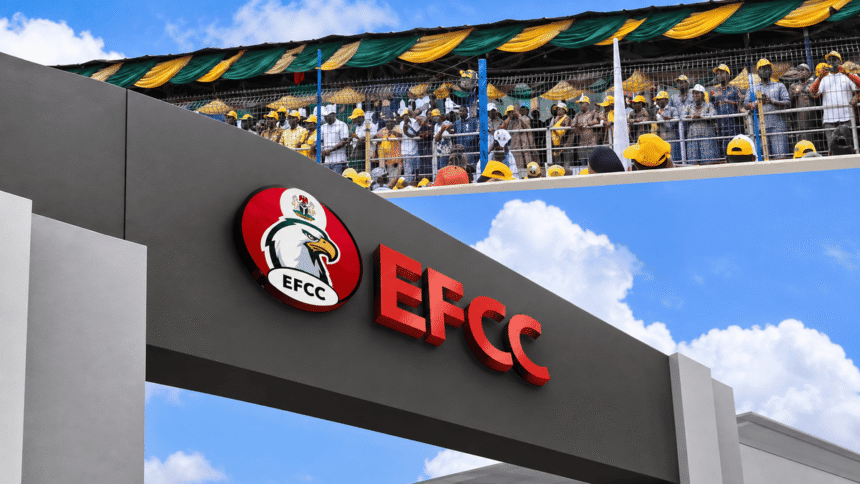
The EFCC has placed a post-no-debit restriction on Osun State’s statutory allocation account at First Bank as part of an ongoing financial investigation.
A letter dated Wednesday and signed by Assistant Commander Adenike Babalola, acting for the Director of Investigation, directed First Bank to freeze account number 2017170947, listed in the document as “Osun State Government Statutory Allocation,” pending the conclusion of the probe. The directive effectively bars any withdrawals or debits from the account until the commission determines that the investigation has been resolved.
The letter, referenced 3000/EFCC/ABJ/HQ/PFS/TA/OSUN/VOL.17/666, was addressed to the managing director of First Bank, with specific attention directed to the chief compliance officer of the institution. The formal routing of the directive to the compliance officer signals the procedural nature of the restriction and the expectation that the bank bears responsibility for enforcing it.

According to the letter, the commission grounded its directive in Section 38(1) and (2) of the Economic and Financial Crimes Commission (Establishment) Act, 2004, and Section 24 of the Money Laundering (Prevention and Prohibition) Act, 2022. These provisions grant the EFCC broad powers to direct financial institutions to restrict access to accounts where funds are suspected to be connected to financial crimes or are required for investigative purposes.
The EFCC stated that the Wednesday directive followed an earlier correspondence dated April 15, 2026, referenced as CR:3000/EFCC/ABJ/HQ/PFS/TA/OSUN/VOL.17/165, indicating that contact with First Bank on this matter predates Wednesday’s action by nearly four months.
“In furtherance to the above, you are kindly requested to place a post-no-debit on the account,” the letter read, adding, “Thank you for your usual cooperation, please.”
Sources within the anti-graft agency told The Punch that the investigation into the Osun State government did not begin recently. According to those sources, the probe had been running for more than a year before Wednesday’s letter was issued.
One source disclosed that a number of senior Osun State government officials had previously accepted invitations from the commission and provided written statements in connection with the investigation. The source emphasized that the timing of the account freeze was driven by investigative developments rather than political considerations tied to the upcoming governorship election.
“We have been investigating the government for over a year. In fact, some top officials of the government had been invited; they came and wrote statements. So it is not because of the forthcoming election,” the source told The Punch.

Calls placed to EFCC spokesperson Dele Oyewale went unanswered on Wednesday. A text message sent to him seeking comment also received no reply before the time of filing.
Hours before the freeze letter became public, Governor Ademola Adeleke of Osun State issued a statement alleging that the EFCC was planning to restrict the accounts of the state government and a number of top officials ahead of the governorship election.
Commissioner for Information and Public Enlightenment Kolapo Alimi issued that statement on behalf of Adeleke. In it, the governor described the reported move as an attempt to cripple the activities of his administration before the poll.
Adeleke challenged the legal basis of the commission’s action directly, arguing that the EFCC lacked the statutory authority to freeze a state government’s accounts under any circumstance.
“There is no legal basis or justification for any push to freeze the state government accounts. The anti-graft agency has no legal powers to freeze the account of a state government,” Adeleke stated in the release issued by Alimi.
The restriction covers the account designated for statutory allocations, which represents funds disbursed to the state from the Federation Account by the federal government on a monthly basis. These allocations form a critical component of the state’s revenue and are typically used to fund salaries, infrastructure, and other recurring government obligations.
Political tension in Osun State is expected to rise following Wednesday’s development, with the governorship election drawing closer and both sides of the dispute now publicly staking out opposing positions on the commission’s authority.