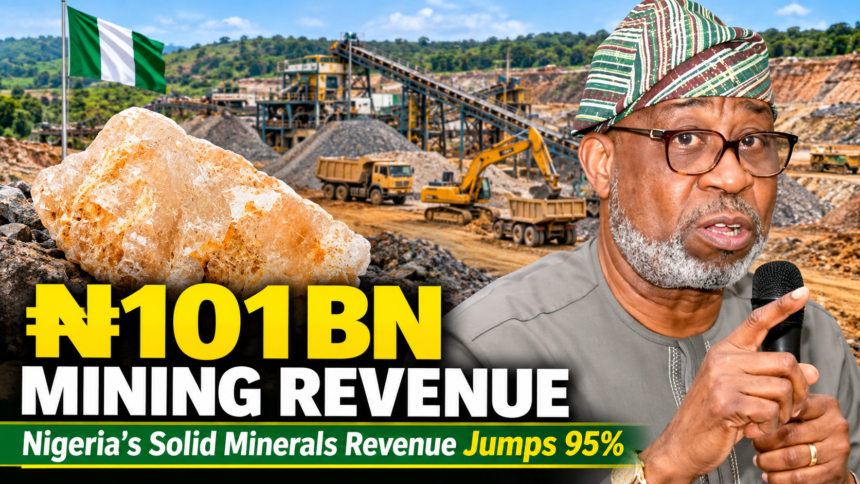
Nigeria’s solid minerals revenue increased by 95.2 per cent to ₦101.11 billion in the first nine months of 2026, up from ₦51.79 billion recorded during the corresponding period in 2025.
The increase represents an additional ₦49.32 billion in government receipts within one year, highlighting the growing contribution of mining-related payments to public revenue as Nigeria intensifies efforts to diversify its economy beyond crude oil.
Data from the Central Bank of Nigeria (CBN) show that the improvement was driven largely by mineral royalties, which accounted for the biggest share of collections during the nine-month period.
Although the figures represent a significant increase in revenue, the composition of the collections also raises questions about how effectively Nigeria is converting its extensive mineral resources into sustainable economic growth.
Solid Minerals Revenue: Royalties Drive ₦101bn Collection
A breakdown of the revenue shows that mineral royalties accounted for ₦66.12 billion, representing approximately 65.4 per cent of the total amount generated between January and September 2026.
Fees collected by the Federal Ministry of Solid Minerals Development contributed ₦33.54 billion, accounting for 33.2 per cent, while miscellaneous receipts stood at ₦1.45 billion.
The figures indicate that royalties associated with mineral extraction and sales have become the largest source of government receipts recorded in the sector.
This distinction is important because mining revenue does not come from a single payment category. Government earnings include royalties, licensing charges, application fees, renewal payments and other administrative receipts.
Royalties are particularly significant because they are linked to the extraction and commercial exploitation of the country’s mineral resources.
The increase therefore reflects stronger collections from mining-related activities, although revenue figures alone do not establish how much mineral production increased during the period.
Nigeria’s Mining Reforms and Revenue Collection
The latest performance comes amid efforts by the Federal Government to improve regulation, formalise mining activities, strengthen revenue collection and attract investment into the sector.
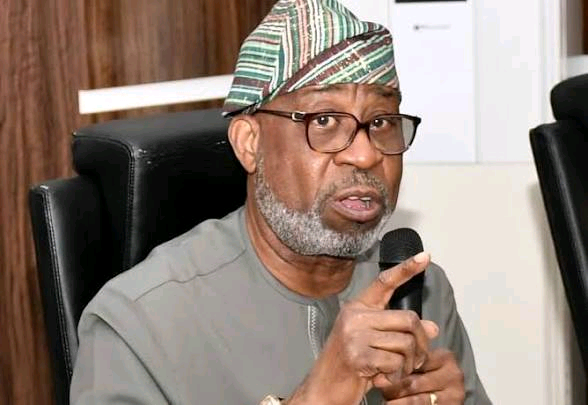
The Ministry of Solid Minerals Development, under Minister Dele Alake, has pursued reforms aimed at reducing illegal mining, improving licensing administration and encouraging greater participation by organised investors.
The government’s efforts have also focused on addressing revenue leakages and improving compliance among mining operators.
In May 2026, the Federal Ministry of Information and National Orientation reported that the Ministry of Solid Minerals Development and the Nigeria Revenue Service had held a stakeholder sensitisation programme on aligning mining operations with the 2025 Tax Reform Act.
At the event, the ministry’s Permanent Secretary, Faruk Yusuf Yabo, stressed the importance of compliance, transparency and collaboration with the Nigeria Revenue Service to optimise revenue from the industry.
The development is significant because the Nigeria Tax Administration Act 2025, which commenced on January 1, 2026, provides the legal framework for changes to revenue administration.
The Nigeria Revenue Service’s involvement in mineral royalty collection forms part of the broader restructuring of revenue administration, while the mining ministry retains its technical and regulatory responsibilities.
These changes are intended to improve accountability and ensure that payments due to the government are properly assessed and collected.
Nigeria’s Mineral Wealth and Untapped Potential
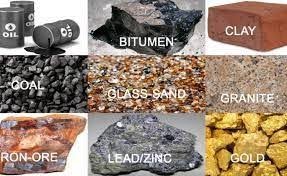
Nigeria possesses considerable deposits of solid minerals, including gold, limestone, lithium, lead, zinc, iron ore, coal, baryte and bitumen.
According to the Ministry of Solid Minerals Development, the country has at least 44 mineral deposits in commercial quantities, distributed across more than 500 locations in its 36 states and the Federal Capital Territory.
Despite this natural endowment, the industry still has considerable room for expansion, particularly in exploration, processing and large-scale commercial production.
A 2023 solid minerals industry audit published by the Nigeria Extractive Industries Transparency Initiative (NEITI) reported that the sector contributed approximately 0.75 per cent of Nigeria’s GDP that year.
The figure illustrates the gap between the country’s mineral resources and the industry’s contribution to the wider economy.
The challenge is not simply generating more money from mining licences and royalties. Nigeria also needs to expand production, develop processing facilities, create employment and retain more value from minerals extracted within its borders.
Without these improvements, increased government collections may not automatically translate into significant industrial development.
Government Pushes for Local Mineral Processing
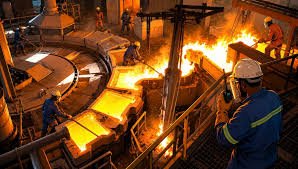
Another major part of the government’s mining strategy is encouraging investors to process minerals locally rather than exporting them primarily as raw materials.
Local processing can create additional economic opportunities through manufacturing, industrial development, technology transfer and employment.
The Federal Government has repeatedly linked its mining reforms to value addition, with the Ministry of Solid Minerals Development promoting investments in mineral processing facilities.
During the inauguration of the Nigeria-US Solid Minerals Committee in October 2026, Alake reiterated the government’s position on local processing.
He said the country was moving away from a system in which minerals were extracted and transported for export without sufficient domestic value addition.
The minister also stated that the government would not grant mineral titles to investors without a clear pathway towards processing minerals within Nigeria.
The policy is intended to ensure that the country benefits beyond the initial extraction of its resources.
For instance, processing minerals domestically can support industries that depend on mineral inputs, potentially strengthening local manufacturing and reducing dependence on imported processed materials.
What the ₦101bn Revenue Means for Nigeria
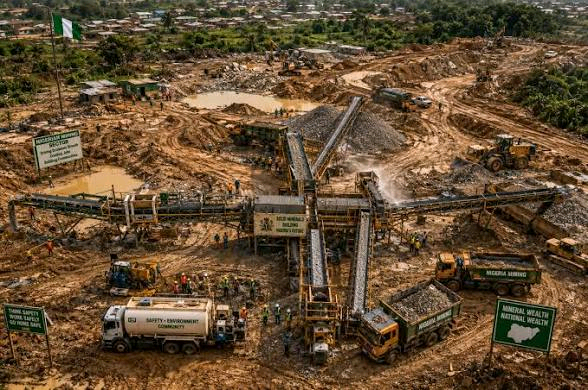
The increase in solid minerals revenue provides an important indication of the government’s improving ability to collect money from the mining industry.
However, the next test will be whether the increase can be sustained and accompanied by stronger production, investment and industrial development.
The difference between the 2025 and 2026 collections is substantial, but revenue growth should not be confused with an equivalent increase in mining output or the sector’s contribution to GDP.
Nigeria must also address persistent challenges, including illegal mining, inadequate infrastructure, security concerns, limited geological information and the need for more investment in exploration and processing.
The government will need to ensure that mining operators comply with regulations, royalties are properly collected and mineral-producing communities benefit from responsible mining activities.
With ₦101.11 billion recorded in the first nine months of 2026, the solid minerals industry has delivered a notable improvement in government revenue.
Whether this momentum develops into a stronger mining economy will depend on the country’s ability to turn higher collections into productive investments, local industries and long-term economic value.