


The first of those stations opened Thursday on Bill Clinton Drive along Airport Road in Abuja, marking what NNPC Limited described as a shift from conventional petrol retailing to multi-energy service points it is calling energy hubs.
Mumuni Dagazau, the Executive Vice President for Downstream at NNPC Limited, confirmed the rollout timeline at the commissioning event. Four or five similar stations are already planned for Abuja, he said, with two more set to launch in Kano.
“This is the first of many smart stations that we are going to have around the country,” Dagazau told reporters at the event. “We are hoping to roll out a significant number, probably about 50 to 70 of these types of stations within the next six months.”
Beyond petrol, each hub will offer electric vehicle charging, liquefied petroleum gas, compressed natural gas, and a vehicle conversion center, according to NNPC. The Abuja station also houses a quick-service restaurant, a coffee shop, an automated car wash, and a modern service bay, making it a more comprehensive stop than a traditional filling station.
Shettima Baba-Kukawa, the Executive Director for Retail Operations and Mobility, disclosed that the Abuja facility holds 180,000 liters of Premium Motor Spirit and 45,000 liters of Automotive Gas Oil. Six EV charging points are installed there in partnership with African Motor Works.
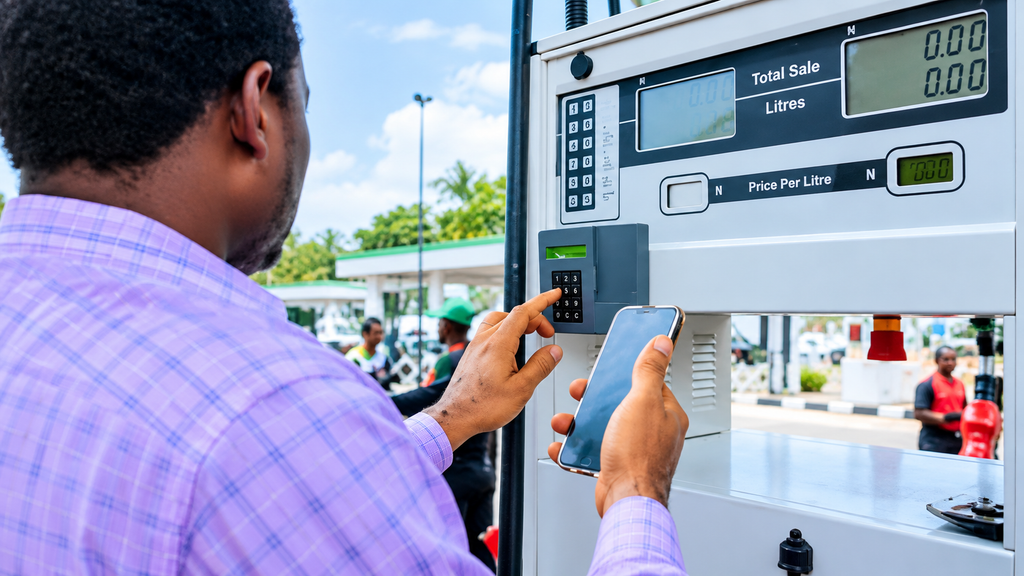
The station runs entirely on solar power through a system rated at more than 200 kilowatts, Baba-Kukawa confirmed. It operates 24 hours a day and is fully self-service for customers who choose to use it.
“Transactions are done on their phone app and concluded by dispensing the exact amount of fuel they purchased into their tanks,” Baba-Kukawa said at the briefing. Customers who cannot use the app will still be served by staff on-site, ensuring the transition to digital payments does not exclude those less familiar with the technology.
Concerns that self-service pumps could displace fuel station workers drew a direct response from Dagazau. He argued that an energy hub employs more people than a conventional filling station because of the technology, EV support, and expanded services it requires.
“If you look at the average filling station and you look at the energy hub, you’ll find more people in the energy hub than you would find in the filling stations,” Dagazau said. Attendants, he noted, remain present at every pump.
Huub Stokman, the Managing Director of NNPC Retail, said at the commissioning that deregulation and the start of operations at the Dangote Refinery had changed what consumers expect from fuel retail. Competitive pricing, digital payments, and alternative energy options are now baseline demands, according to Stokman.
“Especially the younger generation, they want us to deliver it sustainably, hence the fact that you also see that this station is completely solar-powered,” Stokman said. The comment pointed to a generational shift NNPC says is driving the redesign of its retail network.
Dagazau also said NNPC plans to modernize its existing stations, not only build new ones. The pace of that broader upgrade, he noted, would depend on customer demand and the investment each location requires.
Nigeria Immigration Service Comptroller-General KN Nandap, who delivered a goodwill message at the commissioning, said the facility showed Nigeria’s adoption of cleaner energy and smart mobility was advancing. She said such investments could generate employment and support skills development across the sector.
NNPC said its smart-station program is designed to position its retail network for a downstream market reshaped by deregulation, increased domestic refining, and the spread of alternative fuels, with self-service filling stations at the center of that transition. The program reflects a broader effort by the national oil company to modernize its public-facing operations and remain competitive as Nigeria’s energy landscape continues to shift.