


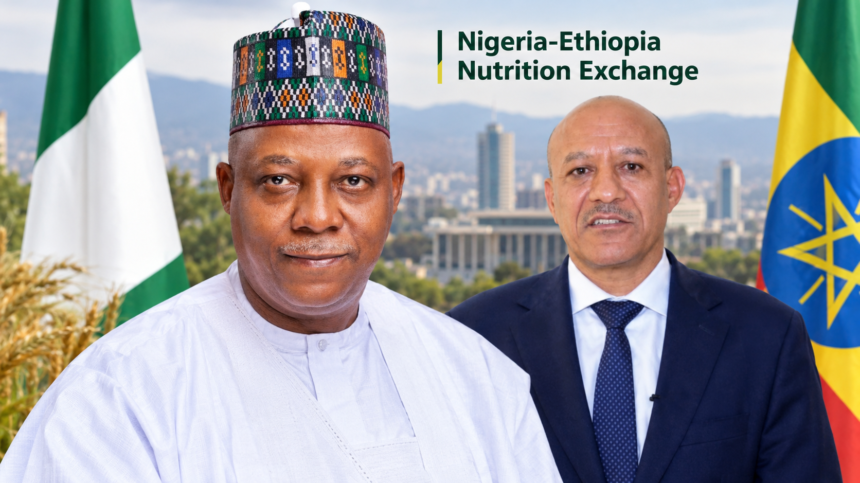
Vice President Kashim Shettima has arrived in Addis Ababa to lead Nigeria’s delegation to a three-day nutrition leadership exchange with Ethiopia focused on improving how nutrition programmes are delivered at community level.
The Nigeria-Ethiopia Nutrition Leadership Exchange Forum is holding from October 7 to 9 at the invitation of Ethiopia’s Deputy Prime Minister Temesgen Tiruneh. Shettima arrived on Tuesday, October 7, ahead of the opening session.
The forum is designed as a learning visit, giving Nigerian officials a chance to study how Ethiopia has built coordination around nutrition across different levels of government and across sectors.
It comes at a time when Nigeria is scaling up its own nutrition response through the Nutrition 774 Initiative, a federal government programme aimed at extending coordinated nutrition interventions to all 774 local government areas.
The Federal Government has also adopted the National Policy on Food and Nutrition 2026-2035 through the National Council on Nutrition. The policy is awaiting ratification by the Federal Executive Council and sets the framework for the next decade of nutrition action in the country.
Why The Exchange Matters Now
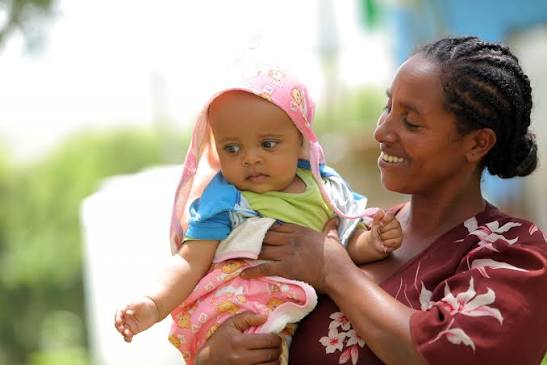
Nigeria is facing a high burden of malnutrition, particularly among children under five. Stunting, wasting and micronutrient deficiencies remain major public health concerns, with effects that go beyond health to education, productivity and long-term economic growth.
The government has identified weak coordination between federal, state and local governments as one of the reasons nutrition interventions have not reached enough communities consistently.
The Ethiopia exchange is intended to address that gap by exposing Nigerian leaders to a system that has kept nutrition on the political agenda for over a decade and has tried to move it from policy documents into practical delivery at woreda and kebele levels.
Ethiopia’s experience is seen as relevant because both countries run federal systems and face similar challenges in taking national programmes to diverse states and local communities.
Why Ethiopia Was Chosen
A major reason for choosing Ethiopia is its Seqota Declaration, launched in 2015 as a 15-year government commitment to end stunting among children under two by 2030.
The Declaration is built on a multisectoral model that brings together institutions responsible for health, agriculture, education, water, social protection and finance. Rather than treating nutrition as a health issue alone, it treats it as an outcome that depends on food systems, household income, clean water, sanitation and knowledge.
The programme was planned in three phases. The innovation phase ran from 2016 to 2020 and was implemented in selected areas of Amhara and Tigray. The expansion phase from 2021 to 2025 took lessons from the innovation phase to more areas. The national scale-up phase began in 2026 and is now being rolled out across the country.
That timeline makes the current visit timely, as Nigeria is meeting Ethiopia at the point where it is moving from expansion to nationwide implementation.
Ethiopia’s Ministry of Health says the innovation phase recorded measurable results. It reported a 7.9 percent absolute reduction in stunting in Amhara and 6.7 percent in Tigray during that period, alongside improvements in other nutrition indicators.
For Nigeria, the lesson is not to replicate Ethiopia’s programme wholesale, but to understand how leadership, planning, financing and accountability were combined to sustain focus and deliver results.
Who Is On Nigeria’s Delegation

Shettima is leading a delegation that cuts across federal ministries and state governments, reflecting the multisectoral nature of nutrition.
On the federal side, the team includes Minister of Budget and Economic Planning Abubakar Atiku Bagudu, whose ministry coordinates national development planning and the Nutrition 774 Initiative, Minister of Agriculture and Food Security Abubakar Kyari, and Director-General of the National Emergency Management Agency Zubaida Umar.
At state level, Governors Dauda Lawal of Zamfara and Umar Namadi of Jigawa are part of the team that arrived in Addis Ababa. Earlier briefings on the approved delegation also listed governors of Kwara, Abia, Cross River, Borno and Osun among expected participants in the exchange.
The inclusion of governors is deliberate. In Nigeria, states and local governments are responsible for primary healthcare, agriculture extension, water and sanitation, and community mobilization – all critical for nutrition outcomes.
Without strong state and local ownership, federal nutrition policies struggle to reach households. The presence of governors signals an attempt to build that ownership from the start.
From Policy To Practical Lessons
The programme for the three days goes beyond conference rooms in Addis Ababa.
The Nigerian delegation is scheduled to visit sites that link food production to nutrition. These include a wheat farm and banana plantation in Oromia, the Bounty of the Basket Training Centre, households in Mojo, and Jabdu Motors in Bishoftu which is involved in agricultural mechanization.
The visits are meant to show how Ethiopia connects increased food production with dietary diversity, livelihoods and household welfare.
This connection is important because food availability alone does not guarantee good nutrition. Families also need access to diverse foods, income to afford them, clean water, good sanitation, healthcare and information on infant and young child feeding practices.
Ethiopia’s approach tries to bring these elements together rather than treating them as separate government programmes.
Nigeria faces a similar challenge. The country produces a wide range of foods but still records high levels of child malnutrition due to gaps in access, affordability, knowledge and healthcare.
What Nigeria Hopes To Take Home

The real test of the exchange will be what happens after October 9 when the delegation returns to Abuja.
The Federal Government has already raised the profile of nutrition through the creation of a dedicated nutrition department, increased budget attention and the launch of the Nutrition 774 Initiative.
The Ethiopia visit offers a chance to refine how that initiative is implemented. Key questions include how to keep nutrition on the agenda of state executives, how to fund it sustainably beyond donor support, how to coordinate ministries that often work in silos, and how to measure progress at local government level.
Accountability is also a major focus. Ethiopia’s model includes regular reviews and data tracking at different administrative levels.
Nigeria is working to strengthen its own nutrition data systems to track whether interventions are reaching the children who need them most.
The exchange also provides a platform for broader bilateral cooperation between Nigeria and Ethiopia. Ethiopia’s state news agency described the visit as an opportunity to share practical development experiences and deepen institutional cooperation.
As the forum opens on October 7, the focus is on nutrition, but the implications are wider. Better nutrition in early childhood improves school performance, productivity and long-term health, with direct impact on Nigeria’s human capital.
Whether the lessons from Addis Ababa translate into lower stunting rates in Nigeria will depend on execution at state and local government level in the months after the visit.