
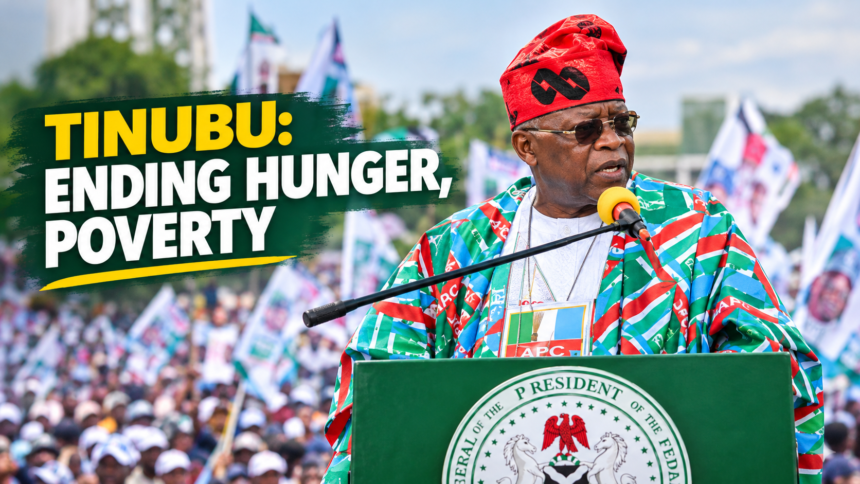
President Bola Tinubu has said his administration is working to eradicate hunger and poverty in Nigeria, blaming previous administrations and political opponents for the economic difficulties facing the country.
Speaking at the All Progressives Congress (APC) presidential campaign flag-off in Kaduna on Saturday, October 24, 2026, the president defended his government’s economic reforms and urged Nigerians to support his bid for a second term in 2027.
Tinubu made the remarks at Ranchers Bees Stadium, where he sought to reassure supporters that his administration’s policies would eventually deliver prosperity, economic recovery and improved opportunities for Nigerians.
His comments have placed the country’s cost-of-living crisis and the responsibility for addressing it firmly in the political conversation ahead of the next presidential election.
Tinubu Blames Opposition for Hunger and Poverty
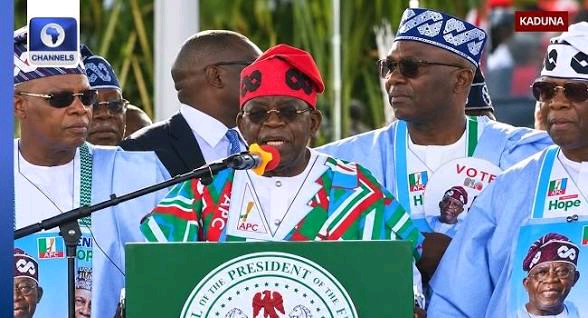
Addressing supporters at the rally, Tinubu challenged opposition politicians who have criticised his administration over hunger and poverty, arguing that the problems predated his government.
“I hear my opponents talking about hunger and poverty. Who created it? They did. They created the hunger; they created the poverty. We are trying to eradicate it,” the president said, according to an official statement published by the State House.
The president also defended the performance of his administration and praised state governors elected on the platform, saying they were working to develop their respective states.
“We pay salaries regularly. Our governors are working, and I am proud of them. They are developing their states,” he said.
Tinubu urged voters to look beyond criticism from opposition parties and consider what his administration describes as progress in economic management and infrastructure development.
His remarks came as political parties began making their cases to voters ahead of the 2027 general election, with economic hardship expected to remain a major issue in the campaign.
Tinubu Promises Prosperity Ahead of 2027 Election

The president used the Kaduna rally to seek another mandate, promising that a second term would focus on prosperity, continuity, growth and development.
Addressing young Nigerians, Tinubu said his administration intended to deliver a better future and urged eligible voters to obtain their Permanent Voter Cards (PVCs) and participate in the election.
He also described his government’s economic programme in terms of recovery and opportunity, maintaining that the country should continue along the path his administration has chosen.
The campaign message follows his Independence Day address on October 1, when he acknowledged the difficulties facing households while arguing that the country needed sustained economic reforms to achieve lasting prosperity.
In that address, Tinubu said: “We cannot erase in four years what accumulated over generations. But we can change its course.”
He added that the government intended to build an economy capable of lifting people out of poverty while ensuring that vulnerable Nigerians received support.
The remarks reflect the administration’s position that Nigeria’s economic difficulties developed over many years and cannot be resolved immediately.
Tinubu Defends Economic Reforms, Fuel Subsidy Removal

Tinubu also defended the direction of his economic reforms, particularly the removal of the petrol subsidy, which has remained a contentious issue since he took office in May 2023.
The government has maintained that ending the subsidy was necessary to address longstanding economic distortions, reduce the financial burden on public resources and create room for more productive spending.
At the Kaduna rally, the president urged supporters not to be persuaded by calls to return to the previous arrangement.
“What is past is past. Fuel subsidy is in our past. No more corruption, no more falsification of invoices, no more lies and no more smuggling,” he said.
The administration argues that its reforms have improved government revenue and created a foundation for economic recovery.
However, the cost of living remains a central concern for Nigerians who continue to face pressure on household budgets.
The challenge for the government is to ensure that the benefits it attributes to its policies translate into more affordable food, transportation and other essential goods and services.
Poverty Reduction Remains a Major Challenge
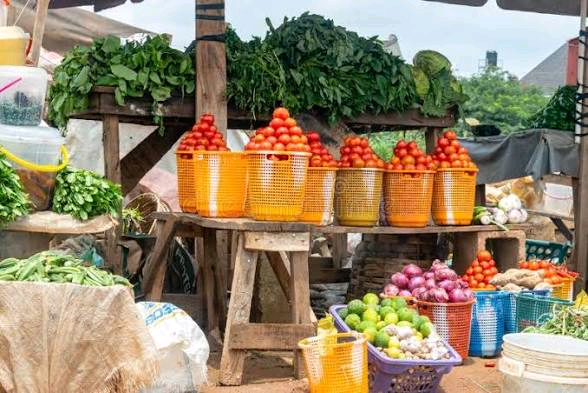
In his October 1 Independence Day address, Tinubu outlined several measures intended to reduce poverty and support households struggling with the cost of living.
These include strengthening direct assistance for poorer families, improving the National Social Register to identify eligible beneficiaries and expanding access to education financing through the Nigerian Education Loan Fund.
He also highlighted the Nigerian Consumer Credit Corporation, known as CREDICORP, which provides consumer financing, as part of efforts to help Nigerians access essential goods and services.
The president said the government was prioritising agricultural production, improved transport links, job creation and support for businesses as part of a broader plan to reduce the cost of producing and distributing goods.
He also acknowledged that millions of Nigerians still struggle to afford food, education, healthcare and transportation.
“Our objective is not to manage poverty more efficiently. We will defeat it,” Tinubu declared in his Independence Day address.
The statement outlined the ambition of the administration’s poverty-reduction agenda, although the scale of the challenge means that sustained improvements in household welfare will be essential to demonstrating its effectiveness.
Tinubu Inaugurates Abuja-Kaduna Highway Section
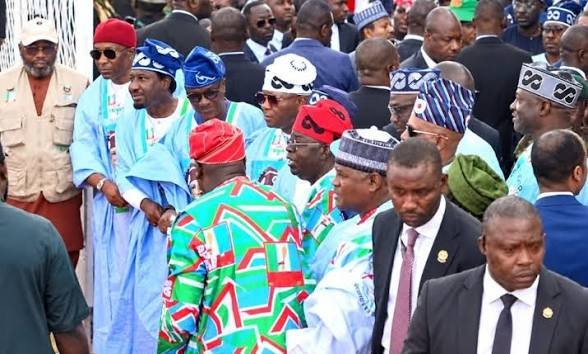
The Kaduna campaign flag-off also featured an infrastructure announcement, with Tinubu inaugurating an 81-kilometre section of the Abuja-Kaduna highway.
The highway project formed part of the administration’s broader infrastructure agenda, which it says is intended to improve transportation and economic activity.
Better roads can help connect farms, businesses and markets, potentially reducing transportation costs and making it easier to move agricultural produce and other goods. However, the effect on household expenses will depend on how infrastructure improvements combine with developments in production, distribution and market prices.
As the 2027 election approaches, Tinubu’s promise to eradicate hunger and poverty will be judged against the everyday experiences of Nigerians.
His administration is presenting economic reforms, infrastructure development and social support programmes as the route to recovery. For voters, the central question will be whether those measures deliver lasting improvements in living standards and make essential goods and services more affordable.