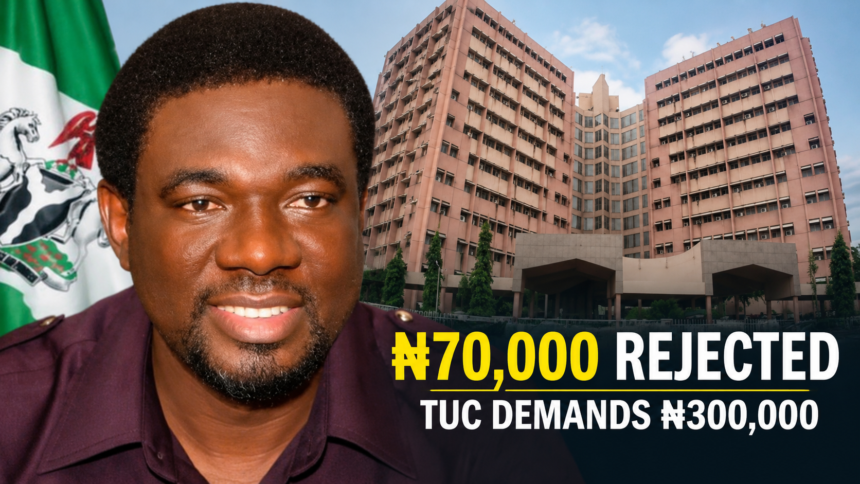
The Trade Union Congress (TUC) has rejected the Federal Government’s proposed ₦70,000 monthly transport allowance, demanding an immediate salary increase that could raise the pay of the lowest-paid federal worker to ₦300,000. The union argues that temporary financial relief cannot adequately address Nigeria’s rising cost of living, insisting that workers need lasting salary adjustments, social protection and the fulfilment of outstanding government agreements.
The disagreement emerged after the Federal Government reached an agreement with the Nigeria Labour Congress (NLC) on October 27, 2026, to provide transport support to public service workers for six months, beginning in November. However, the TUC maintains that a permanent salary increase would offer more dependable relief than another temporary wage award.
TUC Rejects ₦70,000 Transport Allowance

The Federal Government’s proposed transport intervention was among the resolutions reached during a conciliation meeting with the NLC in Abuja on Tuesday, October 27.
Under the agreement, eligible public service workers are expected to receive ₦70,000 monthly for six months, starting in November 2026. The arrangement is intended to cushion the financial pressure facing workers amid rising living costs.
The agreement also provides for payment of outstanding peculiar allowance arrears dating back to May 1, 2026, in three equal monthly instalments beginning in November.
However, the TUC has rejected the temporary intervention, arguing that workers need a more sustainable improvement in their earnings.
In its position, the congress questioned the wisdom of introducing another wage award when previous commitments had allegedly not benefited all eligible workers.
The union cited the October 2023 wage award, which was intended to provide temporary relief until a new national minimum wage was agreed upon in 2024. According to the TUC, some workers received only part of the agreed payments, while others reportedly received nothing.
The congress also alleged that some beneficiaries who received the previous ₦40,000 wage award experienced irregular payments, with instalments arriving after lengthy intervals.
These concerns underpin its opposition to the latest proposal. Rather than repeat an arrangement it considers unreliable, the TUC wants the government to increase salaries directly.
TUC Demands ₦300,000 Minimum Salary

At the centre of the dispute is the TUC’s proposal that the Federal Government raise the salary of its lowest-paid worker from the current ₦70,000 minimum wage to ₦300,000.
The congress argued that the government does not need to wait for negotiations on a new national minimum wage before improving workers’ earnings.
In its statement, the union said: “Some states today have raised their minimum wage above ₦100,000 such that federal government can raise the pay of the lowest worker to ₦300,000 for example from the current ₦70,000 and then apply the applicable consequential adjustment.”
The proposal would represent a substantial increase from the existing statutory minimum wage. The TUC also wants corresponding adjustments to other salary levels to reflect the proposed increase.
The congress maintains that negotiating a new national minimum wage and granting an immediate salary increase are separate matters that the government can address independently.
TUC President Festus Osifo reinforced this position during a television interview on Wednesday, October 28, arguing that the government could intervene in workers’ financial difficulties without waiting for another minimum wage negotiation.
The union’s argument is that a permanent increase would provide workers with a more predictable income, helping them manage recurring expenses such as food, transportation, healthcare and housing.
However, the ₦300,000 figure remains the TUC’s demand, not an approved salary increase. The Federal Government has not announced an agreement to implement the proposed amount.
TUC Raises Concerns Over Previous Wage Agreements
Beyond the transport allowance, the congress has expressed concern about the implementation of previous agreements between the government and organised labour.
The union said the incomplete implementation of the 2023 wage award had weakened confidence in temporary relief measures.
It questioned why workers should be expected to trust another wage award when outstanding payments from an earlier arrangement reportedly remain unresolved.
The TUC also called for measures to reduce the cost of essential goods and services, arguing that the economic pressure extends beyond federal civil servants.
State and local government employees, pensioners, private-sector workers and people employed in the informal economy also face financial challenges, according to the congress.
It urged governments at all levels to ensure timely payment of salaries and pensions, protect existing jobs and take practical steps to reduce the cost of living.
The union further called for the productive sector to be strengthened to support decent employment and improve economic opportunities.
TUC Demands Implementation of JOHESU Agreement
The congress has also demanded the immediate implementation of outstanding commitments involving the Joint Health Sector Unions (JOHESU).
The dispute concerns the adjustment of the Consolidated Health Salary Structure (CONHESS), which determines remuneration for relevant health-sector employees.
According to the TUC, an agreement was reached following negotiations aimed at resolving an industrial dispute involving health workers. The union said the agreement helped pave the way for the suspension of industrial action in good faith.
However, the congress maintains that the government has yet to implement the agreed salary adjustment, despite approximately seven months having passed.
It wants the authorities to implement the adjustment without further delay, provide a clear timetable and make the necessary budgetary provisions.
The TUC argues that health workers should not be expected to continue providing essential services while agreed employment and remuneration commitments remain outstanding.
The congress has pledged to pursue lawful measures to secure compliance with the agreement.
What Happens Next?
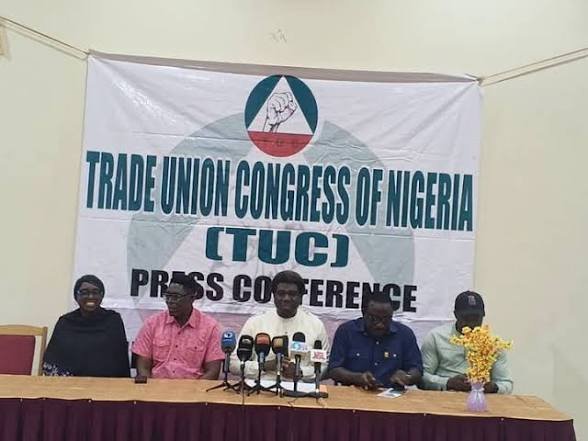
The disagreement leaves workers awaiting further developments on salaries, transport support and outstanding labour agreements.
While the Federal Government and the NLC have agreed on the six-month transport intervention, the TUC is insisting that temporary payments should not replace a lasting improvement in workers’ earnings.
The government and organised labour have also agreed to establish a Minimum Wage Negotiation Committee, although the effective date for implementing a new national minimum wage remained unresolved in the October 27 discussions.
The TUC has said it will await the outcome of its engagements with the Federal Government before deciding on its next steps.
For now, the key issue is whether the government will respond to the congress’s demand for an immediate salary review and address the outstanding commitments raised by the union.
The TUC’s position remains clear: workers need reliable salaries, lower living costs and agreements that are fully implemented, rather than temporary relief that may not reach everyone entitled to receive it.