
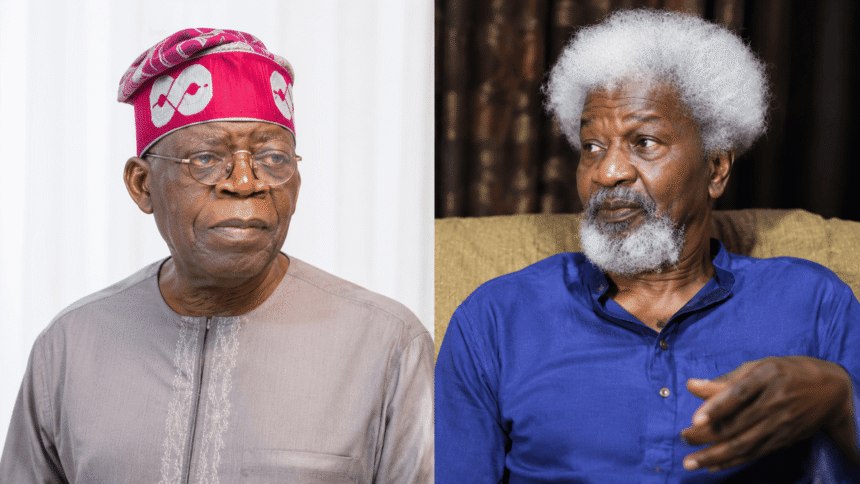
Nobel laureate Wole Soyinka urged President Bola Tinubu to reopen unsolved assassination and extrajudicial killing cases at a Port Harcourt lecture on Friday, citing Tinubu’s own 2023 promise.

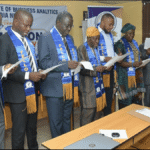
Soyinka called on Tinubu to fulfill his 2023 promise to revisit unresolved cases of assassinations and extrajudicial killings across the country. He made the call at the 28th Wole Soyinka Lecture Series, organized by the National Association of Seadogs (Pirates Confraternity) in Port Harcourt, Rivers State.
The lecture carried the theme “Reclaiming the Nigerian State through Accountability, Justice, and Civic Courage” and was chaired by former managing director of the Niger Delta Development Commission, Chief Timi Alaibe.
Soyinka demanded justice for victims of unresolved killings, including Deborah Samuel, murdered by her classmates in Sokoto State in 2022 after being accused of blasphemy, and 28-year-old Mene Ogidi, allegedly shot dead by a policeman in Delta State.
Soyinka warned against selective justice, accusing the judiciary and citizens of failing to stand against injustice. He stated that perpetrators of crimes, regardless of their status or location, must be identified and punished in accordance with the law.
Soyinka described the lecture series as a tribute to victims of state failures, including six policemen killed in Apo, Abuja. He told attendees the session was dedicated to what he called the martyrs of Nigeria’s failures of governance and civic will.
“I don’t want us to lose that sense that this session is dedicated to the martyrs, to those who have needlessly and avoidably lost their lives,” Soyinka told those gathered at the event in Port Harcourt on Friday.
Soyinka also accused citizens of complicity in injustice, warning that silence in the face of violence amounted to indirect participation in the destruction of human dignity.
In the case of Deborah Samuel, Soyinka expressed concern that one of her classmates allegedly displayed the matchstick used to set her ablaze but had not faced justice years after the incident. He contrasted that with the Delta State case.
Soyinka said the swift arrest of the policeman accused of killing Ogidi contrasted with the handling of Deborah’s case and described the situation as a sign of selective justice operating within Nigeria’s legal system.
“It’s dedicated to individuals, the youths, like Deborah, who was killed, who was butchered by her own classmate, hunted through the city, necklaced, and set on fire,” Soyinka told the audience. “The crime is the silence of the rest of us, that such a thing is possible.”
Soyinka called on Nigerians to join him in demanding that Tinubu retrieve the files. “Watch with me so that we can force the government to bring up all the files,” he said, adding, “I want you to join me in asking President Tinubu to say, ‘We want you to dig up those files.’ “We want to know what happened and why it happened.”
In his keynote address, former minister of aviation Chief Osita Chidoka said justice in Nigeria begins before cases get to court, noting that it starts with how complaints are handled by security agencies.
Chidoka disclosed that 64 percent of inmates in custodial centers were awaiting trial, adding that more than 50,000 Nigerians were being held without convictions. He called the backlog a form of state-administered harm.
“Each of these 50,000 is a life in suspension, a job lost, a family destabilized, someone’s health failing. When the state causes that delay, the citizens pay for it in lost liberty. The delay is not inefficiency; it is a form of violence carried out by the state itself,” Chidoka stated.
Chidoka argued that justice must apply equally, regardless of a person’s identity or political affiliation. Earlier in the program, Alaibe told attendees that sustainable development could not be achieved without accountability.
“Nations are not reclaimed by rhetoric alone; they are reclaimed when conscience triumphs over confidence. When institutions are stronger than individuals,” Alaibe told the gathering, urging all present to treat the lecture as a platform for renewed commitment to rebuilding the country.
Soyinka closed his remarks by pressing Nigerians to ensure that perpetrators of extrajudicial killings do not escape punishment and by calling on Tinubu to act on a promise that, three years after it was made, had produced no public result.