Borno State Governor Babagana Umara Zulum has called on Nigeria’s business community to invest in the state’s post-insurgency recovery, urging companies to create jobs, support displaced families and turn reconstruction efforts into sustainable economic opportunities.
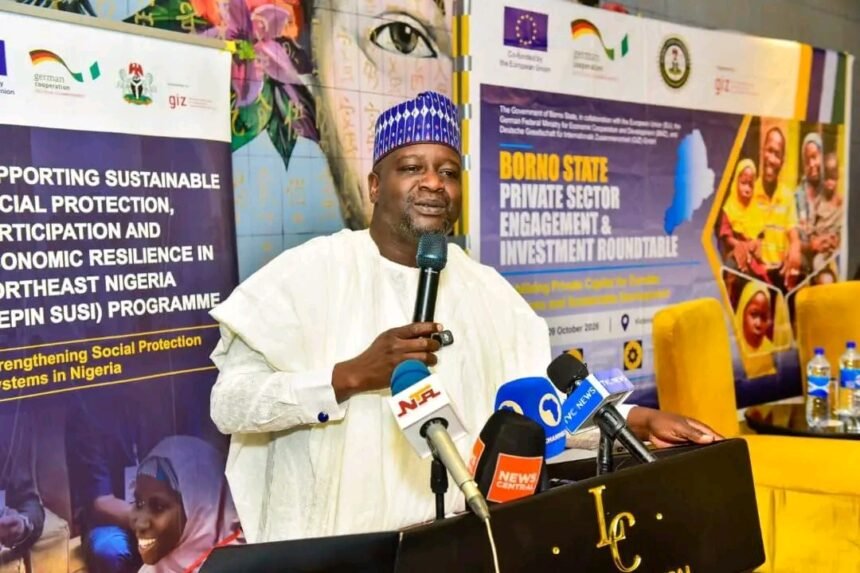
Zulum made the call on Friday at the opening of a two-day Borno State Durable Solutions to Internal Displacement Private Sector Roundtable at the Lagos Continental Hotel, Lagos, where government officials, corporate executives, development partners and philanthropies gathered to discuss ways of mobilising private capital for recovery and development.
Represented by his deputy, Usman Kadafur, the governor said humanitarian assistance had played a critical role in saving lives during the insurgency, but argued that lasting recovery would require displaced families to secure livelihoods, access essential services and become economically independent.
The roundtable, themed “Mobilising Private Capital for Durable Solutions and Sustainable Development,” was designed to encourage stronger partnerships between the state government and private institutions in rebuilding communities affected by years of insurgency.
Zulum urged companies to invest in resettled communities, partner with vocational training institutions and support businesses capable of generating sustainable income. He also called for commitments backed by clear timelines and measurable results.
“A camp cannot become a permanent address. And dependence cannot be the inheritance we pass from one generation to another,” the governor said.
He stressed that returning displaced people to their communities or closing displacement camps would not, on its own, amount to a lasting solution unless families could rebuild their livelihoods and access the services needed to sustain their lives.
“We have learned that closing a camp is not the same thing as ending displacement,” Zulum added.
The governor said Borno’s 25-year development framework was designed to transform the state into a secure and competitive agribusiness and commercial hub through investments in human capital, agriculture, healthcare, environmental sustainability and regional trade.
He urged business leaders to view the state’s recovery not only as a humanitarian responsibility but also as an opportunity to support viable enterprises, expand economic activity and create employment for young people.
As part of the case for private-sector involvement, Zulum highlighted interventions in Monguno, where the state government, the United Nations Development Programme, the Federal Government, Germany and other partners supported the construction of 1,900 permanent homes and semi-permanent shelters.
The programme also provided 375 solar-powered streetlights, while about 4,000 people received grants, technical and vocational training, start-up packages and agricultural inputs. Women accounted for 40 per cent of the beneficiaries, according to the governor.
Other components included water and energy provision, market development, essential services, safety and measures to strengthen social cohesion within resettled communities.
Zulum said the experience demonstrated that housing projects needed to be linked with income-generating opportunities and basic services to ensure that resettled families could sustain themselves.
“Housing alone is not resettlement. Housing plus livelihoods, education, healthcare, security, infrastructure and economic opportunity is what turns a settlement into a community,” he said.
The governor also pointed to education and vocational training as critical components of the state’s recovery strategy, particularly in preparing young people for employment and entrepreneurship.
He said his administration had built 104 new schools and rehabilitated 2,931 classrooms and related facilities by December 2025.
According to him, school enrolment had risen above 1.8 million children, while the estimated number of out-of-school children had fallen below 800,000.
Zulum further disclosed that about 3,000 young people graduated from nine vocational enterprise institutes and centres across the state earlier in 2026. The graduates received tools, starter packs and entrepreneurship support to help them apply their skills and establish businesses.
He urged companies to build on such initiatives by providing investment, mentorship, market access and employment opportunities for trained youths.
“I am therefore not asking you to choose between conscience and commerce. I am asking you to recognise that, in Borno, conscience and commerce can reinforce one another,” the governor said.
He called on companies to direct their corporate social responsibility investments towards projects that could help communities become self-sufficient, including schools, vocational centres, primary healthcare facilities, water systems and support for women and youth entrepreneurs.
Zulum also urged participants to ensure that the roundtable produced concrete commitments rather than ending with discussions and formal declarations.
“I therefore propose that this roundtable must not end with photographs and communiqués,” he said.
He called on investors to help displaced families become homeowners, farmers, employees and entrepreneurs, while creating economic opportunities for young people who could otherwise be vulnerable to recruitment by violent groups.
In separate remarks, the acting Chief of Staff to the Governor, Dr Babagana Mustapha Malumbe, and the Chief Adviser to the Governor on Sustainable Development, Partnership and Humanitarian Support, Dr Mairo Mandara, said the administration was ready to work with private institutions and provide a conducive environment for sustainable investment.
The roundtable attracted representatives of major business and financial institutions, including the Dangote Group and First Bank, alongside development partners such as the UNDP, the United Nations High Commissioner for Refugees, the International Organisation for Migration and the German Corporation.
Members of the Borno State delegation included commissioners responsible for reconstruction, rehabilitation and resettlement; finance; information and internal security; and works and housing. Special advisers, permanent secretaries and the Executive Secretary of the Borno State Investment Promotion Agency, among other officials, also attended.
West Trybe reports that Borno’s appeal for private investment reflects the challenge of moving beyond emergency humanitarian assistance towards durable recovery, with sustainable jobs, viable businesses and access to essential services central to helping displaced families rebuild their lives after years of insurgency.