

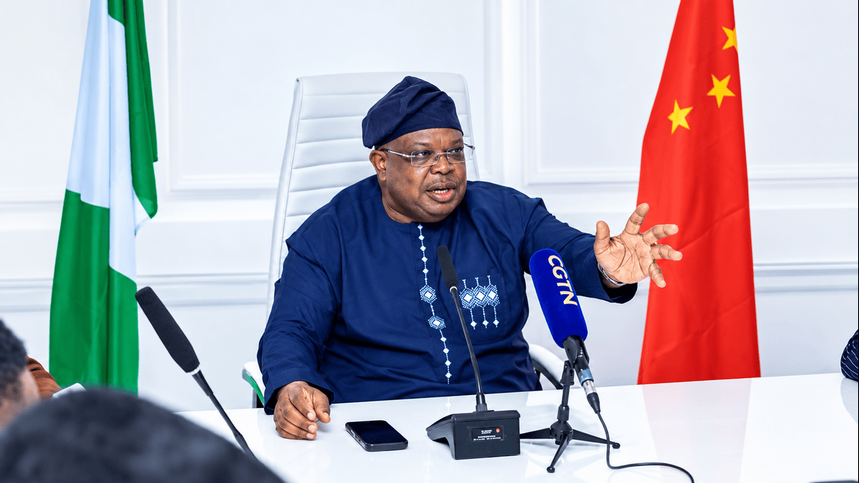
Communities that had no electricity for three straight months are now receiving 18 hours of power daily, according to Power Minister Joseph Tegbe, who said some residents called him asking him to slow down because “everything in their freezer is freezing.”
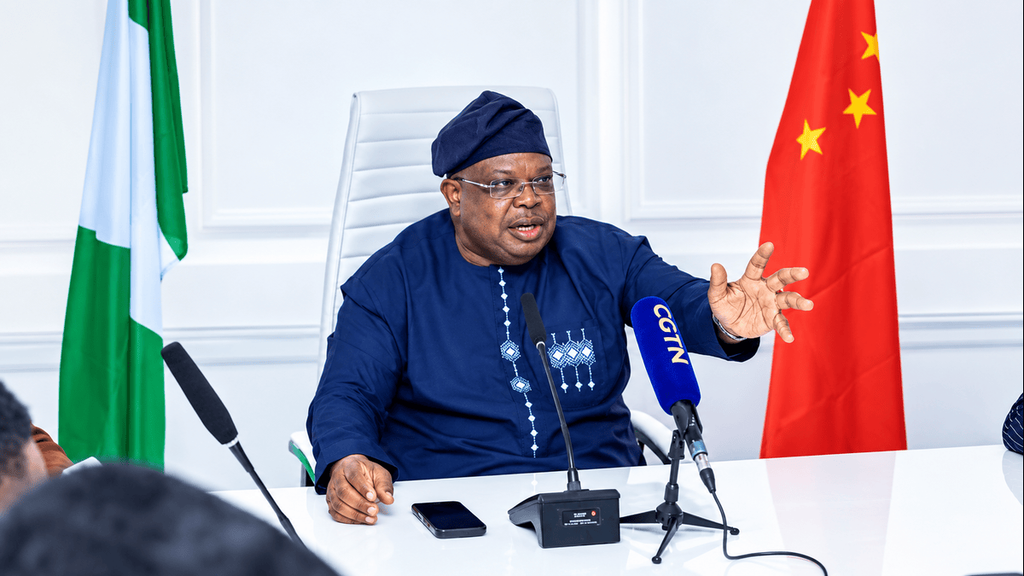
Tegbe spoke on Wednesday at the commissioning of a 3-megawatt solar hybrid power project at Yakubu Gowon University in Abuja.
His response to the complaints was blunt: “That is what a freezer is meant to do. Let it freeze the food that needs to be frozen.”
The minister recalled that during his Senate screening, he told Nigerians they would begin to notice improvements in electricity supply within three to six months. That timeline is now the benchmark against which his tenure will be measured. The screening pledge has given Tegbe’s critics and supporters alike a concrete standard to track progress against as his ministry moves through its early months.
Tegbe acknowledged that serious structural problems remain in the power sector, noting that some of the country’s electricity infrastructure is more than 40 years old and that the government is “systematically replacing them, phasing them out, and bringing new ones.”
Three major transmission towers in Birnin Kebbi had been destroyed by vandals who attacked their foundations and cut sections of the structures for sale in the scrap market.
The affected towers were part of infrastructure supplying electricity to Kebbi State and extending to Niger Republic.
“You will not believe how many towers get pulled down by vandals,” Tegbe said. The Birnin Kebbi case, he confirmed, is not isolated. The minister indicated that such attacks are recurring across the country and represent one of the most persistent and damaging threats to efforts aimed at stabilizing supply.
The Federal Government has established a joint working committee involving the Economic and Financial Crimes Commission, the Nigeria Police Force, and the Nigeria Security and Civil Defence Corps to monitor and protect national electricity assets.
The government is also working to ensure that vandalism of critical electricity infrastructure is treated as a serious criminal offense.
The Yakubu Gowon University facility combines a 3.3-megawatt solar array with 3MW AC output capacity and battery storage to provide reliable electricity to critical university facilities.
Lecture halls, laboratories, ICT facilities, administrative buildings, campus lighting, and other essential services will all draw from the project.
More than 58,726 students are expected to benefit from the project, which has 6,078 photovoltaic panels and 388 streetlights installed across the university. The scale of the installation makes it one of the more substantial renewable deployments at a Nigerian federal university.
The project was delivered under Phase II of the Energising Education Programme by the Rural Electrification Agency, with support from the World Bank-funded Nigeria Electrification Project. Wednesday’s commissioning marked its handover to the institution.
The REA’s Managing Director, Abba Abubakar Aliyu, described the facility as a significant milestone under the Energizing Education Programme. No figure was provided at the event for the total cost of the installation.
The Vice-Chancellor of Yakubu Gowon University, Prof. Hakeem Fawehinmi, said dependable electricity was critical to the institution’s academic mission. His university was formerly known as the University of Abuja before its renaming.
What remains unanswered is how broadly the 18-hour supply figure applies. Tegbe said he had been receiving feedback from electricity consumers following improvements in power supply in some parts of the country, a qualifier that leaves the geographic scope of the gains undefined. Without a clearer breakdown by region or distribution network, it is difficult to assess how many of Nigeria’s electricity consumers are actually experiencing the improvements the minister described.
Tegbe identified vandalism of electricity infrastructure as a major obstacle, saying transmission towers were repeatedly being destroyed for their metal components. The three towers confirmed down in Birnin Kebbi represent a direct hit to cross-border supply reaching the Republic of Niger, not just domestic consumers in Kebbi State.