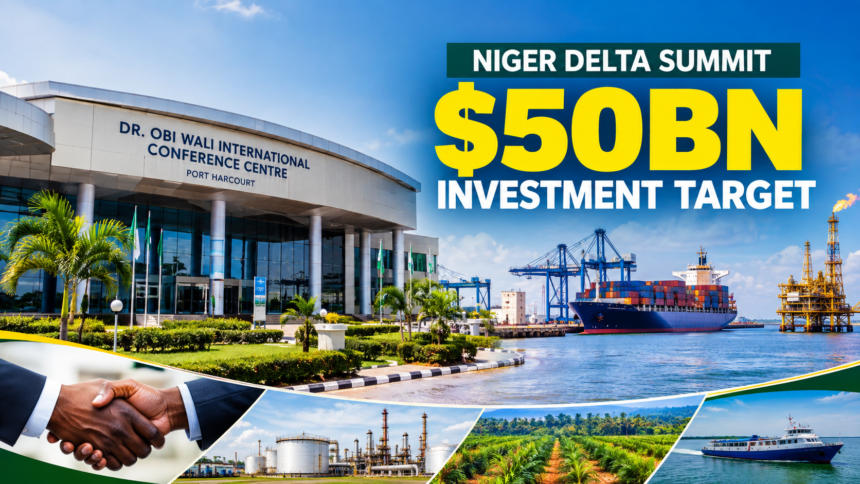
Niger Delta Economic and Investment Summit opens in Port Harcourt on September 15, targeting up to $50 billion in investment commitments across the region’s key sectors.
The Niger Delta Economic and Investment Summit (NDEIS) opens today, September 15, in Port Harcourt, bringing government officials, investors, business leaders and development partners together with a major target: mobilising up to $50 billion in investment commitments for the region.
The three-day summit, which runs until September 17 at the Obi Wali International Conference Centre, is being organised by the Niger Delta Chamber of Commerce, Industry, Trade, Mines and Agriculture (NDCCITMA). The organisers say the event is designed to move the Niger Delta beyond its long-standing dependence on crude oil and position it as a broader investment and industrial hub.
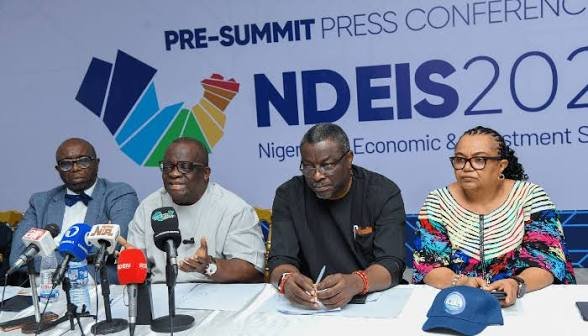
Niger Delta Economic and Investment Summit begins
The 2026 summit is themed “Driving Investment, Innovation and Industrial Growth in the Niger Delta.” It is expected to bring together investors, financial institutions, development organisations, project developers, entrepreneurs and representatives of the nine states commonly associated with the Niger Delta: Abia, Akwa Ibom, Bayelsa, Cross River, Delta, Edo, Imo, Ondo and Rivers.
NDCCITMA says the event will feature about 1,500 delegates and more than 200 exhibitors. At the centre of the summit is an investment-focused Deal Room intended to connect investors with pre-screened projects that can attract financing and partnerships.
The organisers’ broader ambition is to catalyse up to $50 billion in investment commitments over five years through foreign direct investment, joint ventures and structured project financing. That distinction is important: the $50 billion figure is a multi-year investment target rather than money expected to be raised or paid out during the three-day conference itself.

$50bn target puts investment at the centre
The size of the target reflects the organisers’ attempt to turn the summit into more than a gathering for speeches and policy discussions.
According to BusinessDay, the summit’s Deal Room is expected to feature between 30 and 50 vetted, bankable projects drawn from across the Niger Delta states. The projects are intended to give investors a clearer route from initial interest to actual financing and business partnerships.
The organisers have also linked the investment drive to employment creation, with earlier projections putting potential job creation at about 500,000 positions. Whether that figure is eventually achieved will depend on the investments that emerge from the summit and the successful implementation of the projects involved.
That makes the Deal Room one of the most important parts of the event. For the region, the bigger test will not simply be the number of delegates or announcements made during the summit, but whether investors actually commit capital to viable businesses and projects.
Beyond oil, Niger Delta seeks wider opportunities

For decades, crude oil and natural gas have dominated the economic conversation around the Niger Delta. NDEIS is seeking to broaden that picture.
The organisers have identified opportunities in sectors including agriculture and agro-processing, gas and petrochemicals, maritime activities and the blue economy, manufacturing, aviation, transportation, renewable energy, tourism, logistics, infrastructure, financial services and the digital economy.
The push comes as stakeholders increasingly focus on how the region can use its natural resources, coastline, waterways, agricultural potential and human capital to create a more diversified economy.
The Niger Delta Development Commission has also been pursuing investment outside crude oil. In July, the commission and the Federal Government unveiled a $500 million Niger Delta Agricultural Development Investment Fund, aimed at supporting agribusiness and attracting private investment into the agricultural value chain across the nine states.
That initiative provides another example of the wider effort to build economic activity around sectors capable of generating jobs and businesses beyond petroleum.

What investors will be looking for
Attracting billions of dollars into the region will require more than identifying opportunities.
Investors will want bankable projects, reliable infrastructure, predictable policies, access to finance, security, skilled workers and a clear regulatory environment. They will also need confidence that agreements reached at the summit can be implemented after delegates leave Port Harcourt.
NDCCITMA Chairman Idaere Gogo-Ogan has stressed the importance of stronger economic integration among the Niger Delta states. The chamber has called for closer cooperation between the state governments, the Federal Government, the Niger Delta Development Commission, the private sector and development partners.

That regional approach could be significant because investors often look beyond individual state boundaries when assessing markets, infrastructure and supply chains.
Port Harcourt becomes investment meeting point
Holding the summit in Port Harcourt also places the investment discussion inside the Niger Delta itself rather than keeping it centred in Abuja or Lagos.
The choice of venue is intended to showcase the region directly to investors while creating opportunities for businesses, government agencies and project promoters to meet potential partners.
The summit was originally scheduled for May before being postponed to September, giving organisers additional time to prepare the investment programme and Deal Room.

As the event begins, expectations will therefore extend beyond the three days of meetings. The real measure of NDEIS will be what happens afterward: how many projects secure funding, how many partnerships move forward, how much new economic activity is created and whether promised investments translate into jobs and stronger businesses.
For a region with enormous economic resources but a long history of development challenges, the $50 billion ambition is certainly bold. But if the summit succeeds in connecting credible projects with serious investors and turning commitments into actual businesses and infrastructure, it could mark an important step in reshaping the Niger Delta’s economic story.