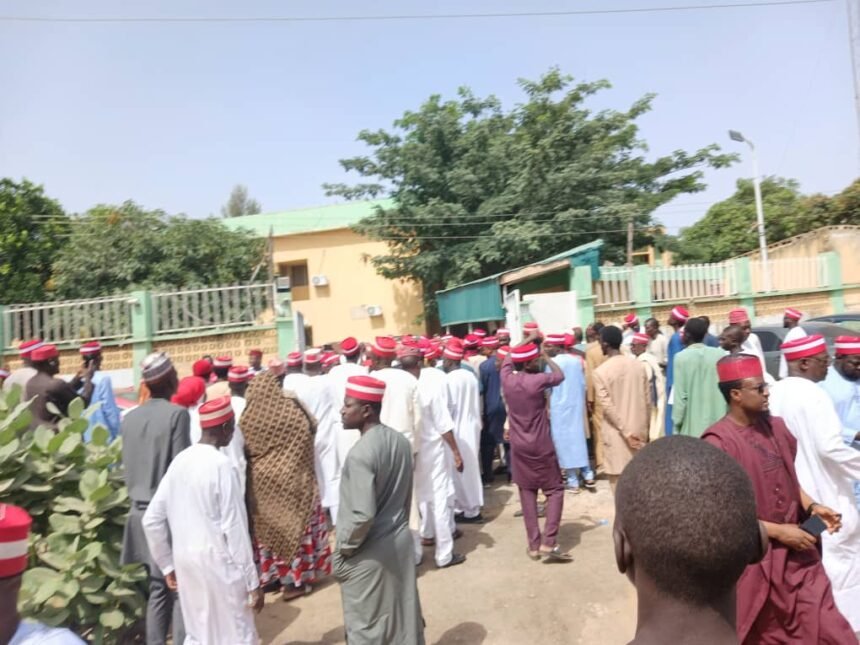
Hundreds of Kwankwasiyya Movement supporters on Friday protested at the Independent National Electoral Commission’s office in Kano, demanding the reinstatement of the National Democratic Congress governorship candidate, Aminu Abdussalam Gwarzo, on the list of candidates for the 2027 governorship election.
The protesters, led by the NDC deputy governorship candidate, Mustapha Kwankwaso, submitted a petition to INEC, seeking an investigation into the alleged irregularities surrounding Gwarzo’s omission and the substitution of some candidates associated with the movement in Kano State.
Speaking on behalf of Gwarzo, Kwankwaso said the party had complied with the commission’s nomination requirements, describing the candidate’s exclusion as unjust and urging INEC to review the matter ahead of the election.
The protesters called on the commission to address their concerns and ensure that the nomination process was conducted transparently.
Receiving the petition, Kano State Resident Electoral Commissioner, Abdu Zango, said INEC had provided an opportunity for political parties affected by omissions from the candidates’ list to submit appeals, with October 24 set as the deadline.
He assured the protesters that their complaint would be forwarded to the commission’s national headquarters for consideration.
Zango also commended the group for conducting a peaceful protest, emphasising the importance of following established procedures in resolving electoral disputes.
He said the petition would be processed through the appropriate channels. However, the information available did not indicate that INEC had reached a decision on Gwarzo’s omission or the allegations raised by the protesters.
In a separate interview, Kwankwasiyya Movement spokesperson, Dr Habib Mohammed, said the petition also sought an investigation into alleged forgery and collusion involving an INEC staff member.
Mohammed alleged that unauthorised letters, some bearing signatures suspected to have been forged, had been submitted to the commission’s national headquarters, resulting in the substitution of some candidates associated with the movement in Kano State.
He further claimed that the movement suspected an INEC staff member of dealing with individuals who were not authorised to communicate with the commission on behalf of the party.
“We have asked INEC to investigate the officer before taking further action,” Mohammed said.
He added that the movement was satisfied with the assurances given by the resident electoral commissioner and expected the petition to be forwarded to the national headquarters for consideration.
The allegations of forgery, collusion and unauthorised communication have not been independently established. An investigation by INEC would be necessary to determine the circumstances surrounding the disputed candidate substitutions and establish whether any wrongdoing occurred.
The controversy comes as political parties prepare for the 2027 general elections, with the publication of candidates’ lists representing an important stage in the electoral process. The omission of a governorship candidate could affect a party’s campaign preparations, mobilisation and participation in the election.
INEC had earlier announced that political parties whose governorship candidates were excluded from the final list could submit complaints concerning the omissions on or before October 24.
The deadline provides affected parties with an opportunity to seek a review through the commission’s established procedures before the electoral process advances further.
For the NDC and the Kwankwasiyya Movement, the outcome of the petition could determine whether Gwarzo’s omission receives further consideration and whether the alleged irregularities involving other candidates are investigated.
West Trybe reports that the dispute highlights the importance of transparent candidate nomination procedures as political parties prepare for the 2027 elections. INEC’s response to the petition and its handling of the allegations will be crucial to resolving the controversy and maintaining public confidence in the electoral process.