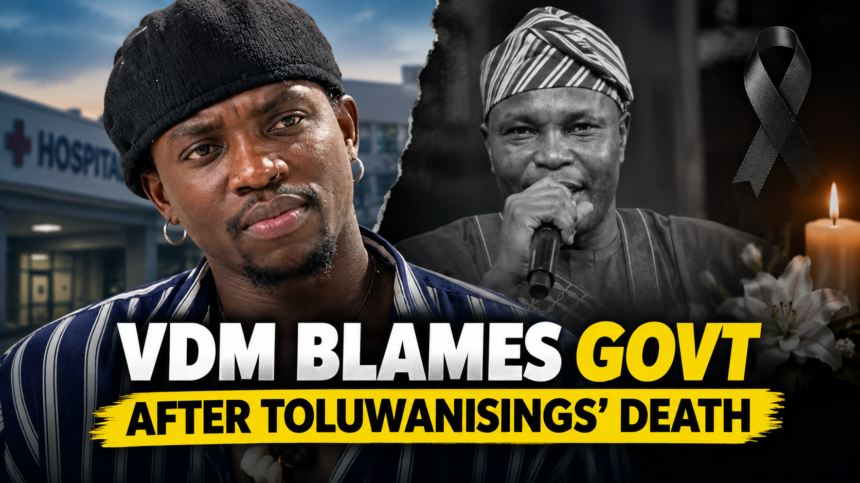
VeryDarkMan has blamed the Nigerian government following the death of gospel singer Toluwanisings, questioning how a country’s healthcare system could leave a person struggling to obtain emergency medical attention. His reaction followed an account from the singer’s personal assistant, who said efforts to secure treatment took them to seven or eight hospitals in Ibadan, with some reportedly citing a doctors’ strike.
The social media activist, popularly known as VDM, argued that the circumstances surrounding the singer’s final hours reflected wider problems with healthcare delivery in Nigeria. His comments have also raised questions about the availability of emergency treatment when patients need immediate attention.
VDM reacts to Toluwanisings’ death

In a post reacting to the singer’s death, VDM expressed anger over reports that Toluwanisings could not obtain medical assistance despite being taken to several hospitals.
He questioned why a person experiencing a medical emergency should have to move from one facility to another without receiving the treatment needed.
VDM said: “Gospel artiste Toluwanisings was rushed to about seven different hospitals, but they were all said to be on strike, and he lost his life. If the hospitals were not on strike, Toluwanisings would be alive.”
He went on to criticise the government, adding: “This is to show you how wicked the Nigerian government is. If we don’t save ourselves from this evil government, no one will.”
The activist’s comments reflected his frustration with a situation in which, according to the account available to him, several hospitals could not provide the required assistance.
He also questioned the disparity between the medical services available to ordinary Nigerians and the options accessible to political officeholders and their families.
VDM argued that government officials could turn to private medical facilities or seek treatment abroad, while many citizens depended on healthcare services that might not be available when emergencies arose.
His reaction has placed the reported hospital visits at the centre of a wider discussion about public healthcare and the consequences of inadequate access to emergency treatment.
What happened during Toluwanisings’ final hours?

Toluwanisings, whose real name was Olayemi Bayonile Bolaji, died in the early hours of Wednesday, October 14, 2026. His family announced his death in a statement shared on his social media accounts.
The announcement described him as a beloved husband, family member and gospel minister but did not disclose the cause of death.
Further details emerged on Thursday when his personal assistant, Babadunni Gbolabo, recounted the attempts to obtain medical attention after the singer suddenly slumped.
Gbolabo said he was not present when the incident happened but received a telephone call and rushed to the singer’s residence.
According to his account, those present tried to revive Toluwanisings before taking him to different hospitals across Ibadan, Oyo State.
He said some facilities reportedly explained that doctors were unavailable because of a strike, while others declined to admit the singer.
“We tried our best to save him, with prayers and everything,” Gbolabo said while recounting the efforts to obtain treatment.He put the number of hospitals visited at approximately seven or eight.
The account provided a clearer picture of the difficulties faced by the singer’s associates as they sought medical assistance. However, the names of all the hospitals involved, their individual responses and the precise medical circumstances surrounding his death have not been established publicly.
The assistant’s account also does not establish whether the reported delays caused or contributed to the singer’s death.
Toluwanisings’ death raises emergency healthcare concerns

The circumstances described by Gbolabo have drawn attention to a critical question: what happens when someone needs urgent medical attention but cannot secure treatment at the facilities they approach?
Emergency situations can require prompt assessment and intervention. When families encounter repeated difficulties finding a hospital able to provide care, the search itself can become an additional source of distress.
The reported visits to several facilities have therefore become central to discussions surrounding Toluwanisings’ death.
However, it is important to distinguish between the reported difficulties obtaining treatment and the still-undisclosed medical cause of death. Without further medical information, it would be premature to conclude that the singer would certainly have survived had a hospital admitted him earlier.
The reported strike-related difficulties also require clarification. Gbolabo said some hospitals cited a doctors’ strike, but the available account does not establish that every facility visited was on strike or explain the circumstances at each hospital.
Those details matter because the incident raises questions not only about industrial action but also about emergency admission procedures, the availability of medical personnel and the response of individual facilities to patients in urgent need.
VDM questions government’s healthcare priorities
VDM’s criticism centres on what he sees as a gap between the healthcare options available to political leaders and those accessible to ordinary citizens.
His argument is that people with substantial resources can arrange private treatment or travel abroad, while Nigerians without comparable means may have to depend on local hospitals.
The activist’s remarks have renewed attention to the responsibility of government at different levels to support a healthcare system that people can access when they need it.
His comments also reflect a broader public concern: access to medical treatment should not depend entirely on a person’s financial position or connections.
Nevertheless, his accusation that government failures were responsible for Toluwanisings’ death remains his assessment of the circumstances, rather than an established medical conclusion.
The available accounts do not identify the specific hospitals involved or establish the extent to which government policy, industrial action or other factors affected the singer’s treatment.
Further clarification from the relevant health authorities and facilities would help establish what happened during the search for medical care.
What Toluwanisings’ passing leaves unanswered

Toluwanisings’ death has left his family, colleagues and fans mourning a gospel minister whose music reached listeners within and beyond the gospel community.
Funeral arrangements are expected to be communicated later.
For now, the account from his personal assistant and VDM’s reaction have placed the circumstances surrounding his final hours under public scrutiny.
Several questions remain unanswered, including which hospitals were approached, what prevented each facility from providing treatment and whether the reported delays affected the outcome.
Those questions are important for establishing the facts rather than relying solely on claims circulating online.
VDM’s reaction has turned attention towards the government’s responsibility for healthcare delivery, but the circumstances of Toluwanisings’ death still require clarification.
For the singer’s loved ones, the loss is personal. For the wider public, the reported struggle to find emergency care has raised a troubling question about what happens when medical help is urgently needed and the path to obtaining it becomes difficult.