
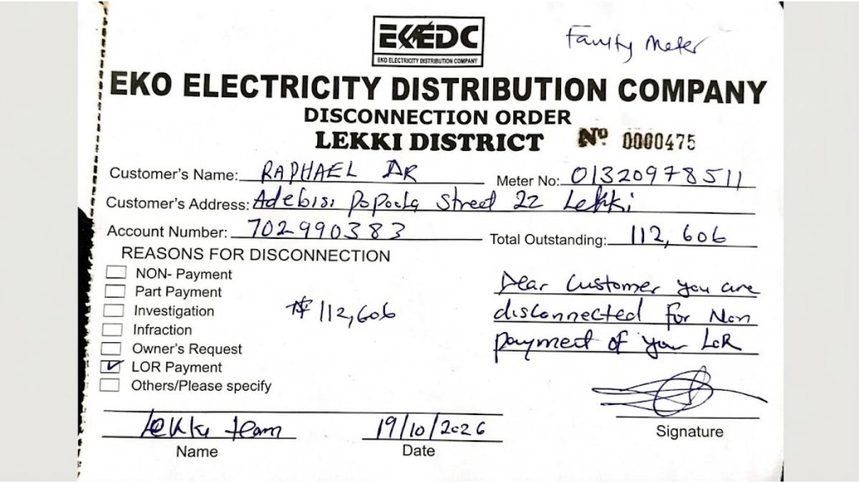
Eko Electricity Distribution Company has handed a Lekki Phase 1 property owner a disconnection notice and a ₦112,606 charge, citing “Loss of Revenue” after the customer reduced his grid consumption by installing an 18-kilowatt solar power system. The customer, Raphael Awoseyin, went public with the incident on Sunday, calling it a brazen attempt by a desperate utility company to punish consumers who have legally reduced their dependence on the grid.
Awoseyin said he installed the solar system at his Lekki Phase 1 property and relegated EKEDC supply to backup status, using grid power only at night. The moment his daytime meter readings dropped to near-zero, EKEDC personnel began making repeated visits to inspect his prepaid meter.
Solar User Forced to Demo Meter to Prove He Was Not Bypassing Grid
On one visit, EKEDC officials stood watching the meter for any sign of movement. When the dial stayed still, they called Awoseyin and accused him of bypassing the meter. He told them his solar system was powering his daytime load and that grid power only kicked in after dark. To settle the dispute on the spot, he switched off his inverter for about two minutes, routing consumption directly through the EKEDC meter. The meter rotated normally. The team had no technical grounds to proceed. One of the officials was overheard muttering a Pidgin English expression expressing frustration that the customer was not allowing them to “eat.”
The team left without taking action. Awoseyin thought the matter was closed. It was not.
EKEDC Returns With Disconnection Notice, Demands Payment for ‘Revenue Lost’
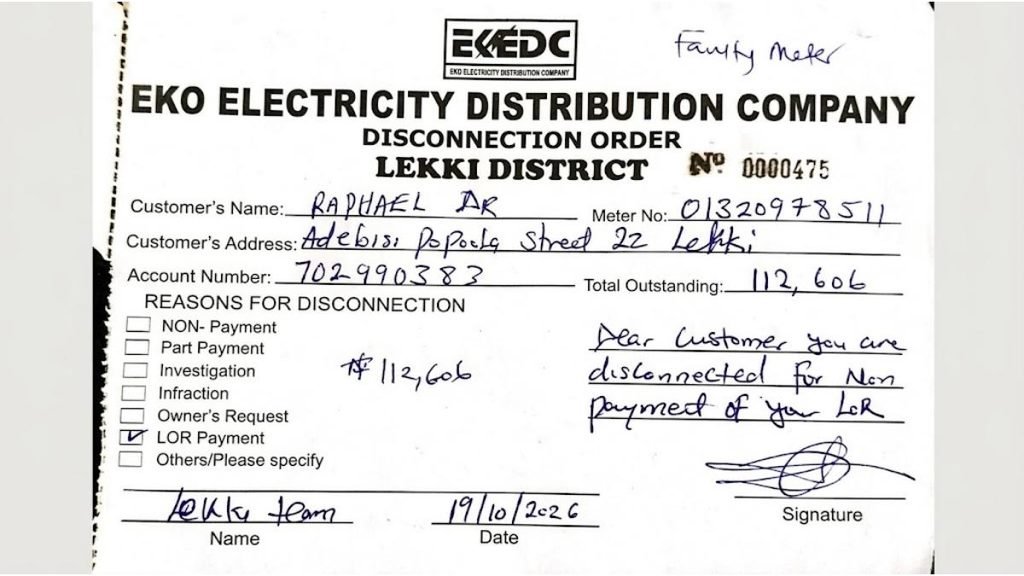
On Sunday, three EKEDC officials returned to his property carrying a formal notice of disconnection. The stated ground was “LOR,” Loss of Revenue. The officials told him his low consumption pattern indicated a faulty meter and that he owed ₦112,606 to compensate the company for revenue it had not earned from him. The last token Awoseyin loaded was in July 2026, and he said he still had units remaining on the meter at the time of the visit.
Awoseyin rejected the demand outright. He told the officials his meter was functioning correctly and offered to let them test it. The response from one official, he said, was that the company was losing revenue and needed to recover it. He declined to pay.
The incident is drawing sharp attention because it arrives at a moment when Nigeria’s distribution companies are under severe financial pressure. Nigeria’s 11 DisCos recorded a combined revenue loss of ₦129 billion in the second quarter of 2026 alone, with aggregate technical, commercial, and collection losses standing at 36.23 percent against a regulatory target of 16.92 percent, according to data from the Nigerian Electricity Regulatory Commission. EKEDC, one of the stronger performers among the 11 DisCos, reported six-month billed revenue of ₦39.5 billion and reduced its ATC&C losses to 19.71 percent as of mid-2026, but the sector-wide liquidity crisis is deepening.
The financial strain does not give EKEDC legal cover for the demand it served on Awoseyin. NERC’s Customer Protection Regulations are explicit on the point. A distribution company cannot disconnect a customer for non-payment where the customer has paid amounts billed or where no valid outstanding bill exists. NERC also recently reaffirmed that consumers wrongfully disconnected are entitled to energy credits equivalent to three months of average consumption for each day the wrongful disconnection persists.
Further, NERC launched the Net Billing Regulations 2026 in June, a framework that formally recognizes consumers who generate solar power for personal use and allows them to sell surplus electricity back to DisCos. The regulation is a direct signal from the regulator that reduced grid dependence by solar users is not only lawful but also encouraged policy. Penalizing a customer for consuming less grid power runs against the direction of that framework.
Awoseyin said he has no intention of paying EKEDC and is waiting for the company to carry out the disconnection so he can file a formal complaint with NERC. Under NERC’s published consumer rights guidance, customers are entitled to written notification ahead of any disconnection and have the right to file complaints and receive prompt investigation.
The case is a sharply lit example of what consumer advocates have warned about for years: that DisCos, squeezed by their own operational failures and rising arrears, are shifting the burden onto compliant, metered, bill-paying customers rather than fixing the inefficiencies that drive their losses. For the millions of Nigerians who have invested in rooftop solar to escape unreliable grid supply, the Awoseyin case signals that the fight for energy independence is not yet over.